

Voice Feminization: What Is It and How Does It Work?


Voice is an important part of how we express ourselves and how other people perceive us. For some transgender, nonbinary, and gender-diverse people, the way their voice sounds may not feel aligned with their gender identity or how they want to be perceived.
Voice feminization is one approach that can help people explore and develop a voice that feels more comfortable, authentic, and aligned with their personal goals.
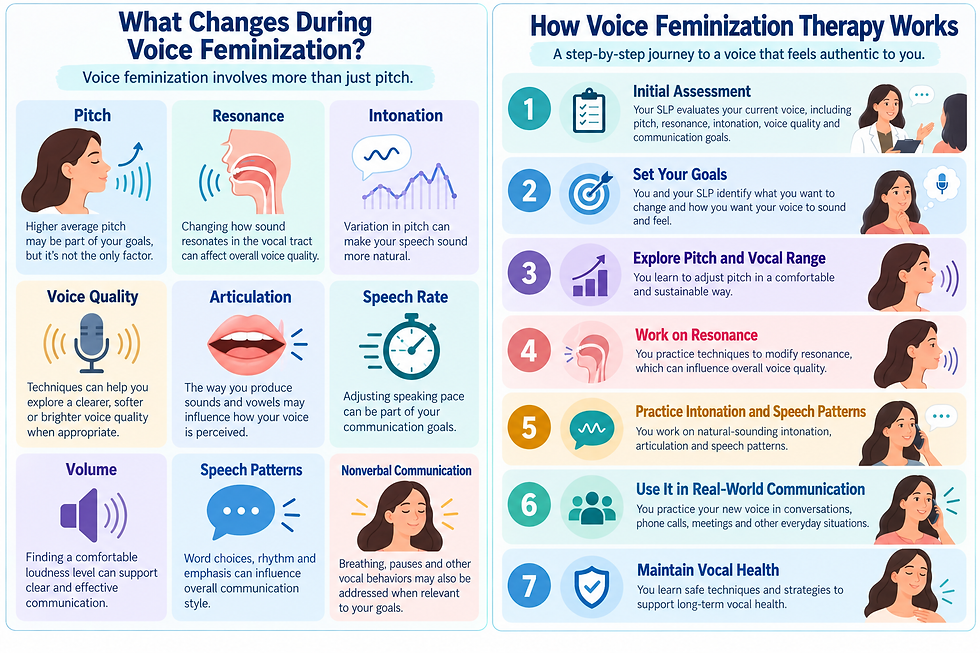
Importantly, voice feminization isn't simply about making a voice "higher." A person's perceived voice can be influenced by several factors, including pitch, resonance, intonation, voice quality, articulation, speech patterns, and communication style. The specific goals of therapy should be determined by the individual rather than by a fixed idea of what a feminine voice is supposed to sound like.
The American Speech-Language-Hearing Association (ASHA) guidance on gender-affirming voice and communication emphasizes individualized, client-centered goals for gender-affirming voice services.
What Is Voice Feminization?
Voice feminization is the process of modifying aspects of voice and communication to create a voice that an individual feels is more feminine or better aligned with their gender identity and communication goals.
It may involve working on several characteristics of speech and voice, such as:
Pitch
Resonance
Intonation
Voice quality
Articulation
Speech rate
Loudness
Vowel production
Communication patterns
Nonverbal vocalizations
Not everyone wants to change all of these characteristics. One person may primarily want to explore pitch, while another may be more interested in resonance or the overall quality of their voice.
That's why voice feminization therapy is generally individualized rather than based on a single formula.
There is also no single way that a feminine voice must sound. People have naturally different voices, accents, dialects, speaking styles, and vocal characteristics. The goal of gender-affirming voice therapy is not to make everyone sound the same.
Instead, the goal is to help a person develop communication patterns that feel comfortable and authentic to them.
Who Can Benefit From Voice Feminization?
Voice feminization may be considered by people who want their voice to feel more aligned with their gender identity or personal presentation.
This may include:
Transgender women
Transfeminine people
Nonbinary people
Gender-diverse people
People who want to explore a more feminine vocal presentation
People who want greater flexibility between different voice presentations
You don't have to have a particular type of voice or a specific reason for wanting to explore voice feminization.
Some people seek therapy because they feel uncomfortable with their current voice. Others may want to feel more confident in social situations, professional settings, or everyday conversations.
For some people, the goal may be relatively subtle—for example, making their voice sound somewhat more feminine while still maintaining characteristics of their natural voice.
For others, the goal may involve more significant changes across several aspects of communication.
Why Do People Choose Voice Feminization?
There isn't one reason why someone may want to feminize their voice.
For some people, their voice may feel inconsistent with their gender identity. Others may feel uncomfortable when they hear recordings of themselves or when people perceive their gender differently from how they identify.
Some common reasons people explore voice feminization include:
Feeling More Comfortable With Your Voice
Your voice is something you use every day. If the way it sounds doesn't feel right to you, changing aspects of your voice may help you feel more comfortable communicating.
Improving Confidence
Some people feel more confident when their voice better reflects how they see themselves.
This may be particularly important during:
Social conversations
Video calls
Phone calls
Presentations
Interviews
Workplace interactions
Public speaking
Reducing Gender Incongruence
For some transgender and gender-diverse people, voice can be an important part of gender affirmation.
A voice that feels more aligned with one's identity may contribute to greater comfort and satisfaction with communication.
Feeling More Consistent Across Different Situations
Someone may feel comfortable with their voice in one setting but become less comfortable during situations such as phone calls or introductions.
Voice therapy can help people develop greater control over their voice so they can use their preferred vocal presentation more consistently.
Developing Vocal Flexibility
Not everyone wants one fixed voice.
Some people may want the ability to move between different vocal presentations depending on the situation. Therapy can sometimes focus on developing greater control and flexibility, rather than simply changing one permanent characteristic.
Does Voice Feminization Only Mean Raising Your Pitch?
No.
This is one of the most important things to understand about voice feminization.
Pitch is certainly one component that can influence how a voice is perceived, but pitch alone does not determine whether a voice sounds feminine, masculine, or somewhere in between.
Two people can have a similar pitch but sound quite different because of differences in resonance, vocal quality, intonation, articulation, and other characteristics.
ASHA's guidance on gender-affirming voice and communication describes therapy as potentially addressing multiple aspects of voice and communication rather than focusing exclusively on pitch.
Pitch
Pitch refers to how high or low a voice sounds.
It is related to the rate at which the vocal folds vibrate. Raising pitch may be one goal of voice feminization, but it should be approached carefully and within a person's comfortable vocal range.
Trying to force the voice significantly higher than is comfortable can contribute to vocal strain.
Resonance
Resonance refers to how sound is shaped and amplified as it travels through the throat, mouth, and other parts of the vocal tract.
Changing resonance can influence the overall quality and perception of a voice, even when pitch doesn't change dramatically.
This is why voice feminization isn't simply a matter of "speaking higher."
You can learn more about resonant voice therapy and exercises to understand how resonance is addressed in speech therapy.
Intonation
Intonation refers to changes in pitch during speech.
Rather than speaking at exactly the same pitch throughout a sentence, natural speech involves changes in pitch to communicate emphasis, emotion, questions, statements, and other meanings.
Voice therapy may explore intonation patterns based on the individual's goals.
Voice Quality
Voice quality describes characteristics such as whether a voice sounds breathy, clear, rough, strained, soft, or resonant.
Voice feminization may involve exploring voice quality when that is relevant to the person's desired sound.
Articulation and Speech Patterns
The way someone produces vowels, consonants, words, and other speech patterns can also influence how their communication is perceived.
These areas may be addressed when they are relevant to an individual's goals—but they should not be treated as mandatory characteristics of a feminine voice.
How Does Voice Feminization Therapy Work?
Voice feminization therapy generally begins with understanding your current voice and what you want to change.
An SLP may assess different aspects of your voice and communication before developing an individualized treatment plan.
The process may include:
Voice assessment
Goal setting
Exploring pitch and vocal range
Working on resonance
Practicing intonation and speech patterns
Developing vocal health and safe technique
Applying new techniques to everyday communication
The exact combination depends on the individual's starting point and goals.
Voice Assessment
An SLP may begin by listening to your voice and assessing characteristics such as:
Pitch
Vocal range
Resonance
Intonation
Voice quality
Loudness
Articulation
Speech patterns
Vocal endurance
Communication habits
The assessment isn't about determining whether your voice is "feminine enough."
Instead, it helps the therapist understand how your voice currently works and which changes may help you achieve your goals.
Setting Your Voice Goals
After the assessment, you and your SLP can discuss what you actually want your voice to sound and feel like.
For example, your goal might be:
"I want my voice to sound slightly brighter."
"I want to feel more comfortable hearing myself speak."
"I want to change my resonance."
"I want my voice to feel more feminine during conversations."
"I want to sound more feminine on the phone."
"I want more control over my vocal presentation."
These goals help shape the therapy process.
There is no requirement to pursue every possible voice modification.
The goal is to develop a voice that works for you.
Exploring Pitch
If changing pitch is part of your goal, an SLP can help you explore your comfortable vocal range rather than simply instructing you to speak as high as possible.
The focus should be on producing the desired voice comfortably and sustainably.
A voice that sounds higher but causes constant throat tension, discomfort, or fatigue isn't necessarily a successful outcome.
Working on Resonance
Resonance can be another important component of voice feminization.
An SLP may help you explore how changes in vocal tract configuration affect the way your voice sounds.
This can be particularly useful because perceived voice characteristics aren't determined by pitch alone.
Practicing Intonation and Communication
Once you begin exploring individual voice characteristics, therapy can progress toward more natural speech.
This may include practicing:
Individual sounds
Words
Sentences
Reading
Conversations
Professional communication
Social interactions
Phone calls
The goal is to gradually make the new communication patterns feel more natural rather than requiring constant conscious effort.
Can Voice Feminization Be Done Without Surgery?
Yes.
Voice feminization therapy is a nonsurgical approach that can help people modify aspects of their voice and communication.
It may address pitch, resonance, intonation, voice quality, articulation, and other communication characteristics depending on the individual's goals.
Surgery is a separate option that changes physical structures involved in voice production. It isn't necessary for everyone who wants to explore voice feminization.
Research on gender-affirming voice and communication therapy has found improvements in several voice-related outcomes, although results vary between individuals and the evidence base continues to develop. A recent systematic review, for example, examined outcomes involving acoustic measures, listener perception, and self-perception following gender-affirming voice and communication interventions.
For many people, beginning with a qualified SLP can provide an opportunity to understand what can be achieved through behavioral voice therapy before considering other options.
Is Voice Feminization Only for Transgender Women?
No.
Gender-affirming voice therapy can support people with a range of gender identities and communication goals.
For example, a nonbinary person may want a voice that sounds more feminine in some situations without wanting to adopt a traditionally feminine voice all the time.
Another person may want a more gender-neutral voice.
Someone else may want the ability to intentionally shift between different vocal presentations.
The important question is not "What should this person's voice sound like?"
It's:
"What voice does this person want to develop, and how can we help them use it comfortably and safely?"
That client-centered approach is consistent with current professional guidance on gender-affirming voice and communication.
Is Voice Feminization Therapy Safe?
When performed with appropriate guidance, voice feminization therapy is designed to help you explore changes in your voice without unnecessarily straining the vocal mechanism.
This is important because changing the way you speak can involve unfamiliar vocal behaviors. Trying to force your pitch higher or maintain a new voice through excessive muscular effort can lead to vocal fatigue, discomfort, or voice problems. ASHA specifically recommends that gender-affirming voice services include attention to vocal health and safe voice production. ASHA
Why Professional Guidance Matters
You may find online videos that encourage you to:
Raise your pitch as high as possible
Change the position of your tongue or mouth
Speak in a particular vocal register
Imitate another person's voice
The problem is that a technique that works comfortably for one person may not work comfortably for another.
An SLP trained in gender-affirming voice and communication can help you determine which techniques are appropriate for your voice and monitor whether you're producing the new voice efficiently.
ASHA notes that modifying pitch, mouth shapes, or other aspects of voice without appropriate guidance can contribute to vocal fatigue and dysphonia and, in some circumstances, more serious vocal problems. ASHA
Signs You May Be Overworking Your Voice
Pay attention if voice practice causes:
Persistent hoarseness
Throat pain or discomfort
Vocal fatigue
A feeling of excessive tension
Difficulty producing your normal voice afterward
Increasing effort required to speak
If you experience persistent voice problems, an SLP may recommend evaluation by an otolaryngologist or another appropriate medical professional.
The objective of voice feminization isn't simply to produce a particular sound. It should also be comfortable and sustainable.
Can You Practice Voice Feminization at Home?
Yes. Home practice can be an important part of voice therapy.
However, the most useful exercises are generally those that have been selected for your individual voice and goals.
Your SLP may recommend practicing things such as:
Vocal exercises
Pitch exploration
Resonance exercises
Vowel modification
Intonation patterns
Words and phrases
Reading aloud
Conversation
Real-world communication scenarios
ASHA lists several approaches that clinicians may incorporate into gender-affirming voice services, including resonant voice therapy, flow phonation, vocal function exercises, semi-occluded vocal tract exercises, diaphragmatic breathing, pitch modification, and vowel modification. ASHA
Why Consistent Practice Matters
Learning a new way of using your voice is similar to developing any other motor skill.
You may initially need to think consciously about what you're doing.
With practice, however, the goal can be to make the new vocal pattern increasingly natural and easier to use during spontaneous communication.
A typical progression might look like:
Exercise → sound → word → phrase → sentence → reading → conversation → everyday communication
The exact progression depends on the person and their therapy plan.
What Does a Voice Feminization Therapy Session Look Like?
There isn't one standard session format for everyone.
A session might include several different activities depending on your current abilities and goals.
1. Voice Check-In
Your SLP may ask how your voice has felt since the previous session.
You might discuss:
Vocal comfort
Fatigue
Difficult speaking situations
Progress with home practice
Situations where the target voice feels easier or harder to maintain
2. Vocal Warm-Up
Some sessions may begin with exercises designed to encourage comfortable, efficient voice production.
The purpose isn't necessarily to make your voice immediately sound feminine. Instead, warm-ups can help you explore voice production while paying attention to ease and vocal comfort.
3. Targeted Voice Work
Depending on your goals, the session may focus on:
Pitch
Resonance
Intonation
Voice quality
Articulation
Vowel production
Speech patterns
You may work on one component at a time or combine several components.
4. Functional Speech Practice
Eventually, exercises need to move beyond isolated vocal tasks.
You may practice:
Introducing yourself
Talking about your day
Ordering something
Participating in a meeting
Making a phone call
Having a casual conversation
Giving a presentation
This helps connect therapy exercises with the situations in which you actually want to use your voice.
5. Feedback and Home Practice
Your SLP may provide feedback about what is working and what needs adjustment.
You may then receive individualized exercises to practice between sessions.

How Long Does Voice Feminization Take?
There is no universal timeline for voice feminization therapy.
Some people notice changes relatively quickly, while others need more time to develop consistent control over their new voice.
Your timeline can depend on:
Your starting voice
Your goals
Which aspects of communication you want to change
How frequently you attend therapy
How consistently you practice
How easily you can carry the new voice into conversation
Your vocal health
Whether you want one specific change or a broader change in communication
It's also possible for progress to happen unevenly.
For example, you might become comfortable with a new pitch relatively quickly but need considerably more practice to maintain the desired resonance during spontaneous conversation.
Research supports the potential effectiveness of gender-affirming voice and communication therapy, but studies also show variation in outcomes and emphasize the need for further research. A 2025 systematic review found improvements in acoustic measures, listener perceptions, and self-perceptions across the studies it reviewed. PubMed
A separate systematic review and meta-analysis of voice feminization interventions also found significant improvements in speaking fundamental frequency among participants receiving voice therapy, although this should not be interpreted as a guarantee of a particular result for an individual. PubMed
Voice Therapy vs. Voice Feminization Surgery
Voice therapy isn't the only possible approach to voice feminization.
Some people explore surgical options, while others use voice therapy alone. Some may use a combination of approaches.
The two approaches are fundamentally different.
Voice Feminization Therapy | Voice Feminization Surgery |
Nonsurgical | Surgical |
Uses behavioral voice techniques | Alters physical structures involved in voice production |
Can address pitch, resonance, intonation, and communication | Primarily produces physical changes to the voice mechanism |
Goals can be adjusted over time | Surgical changes may be permanent |
Focuses on vocal function and communication | Requires medical and surgical evaluation |
No surgical recovery period | Requires recovery and carries surgical risks |
Voice therapy can also be used before or after surgery when appropriate.
Importantly, surgery isn't a requirement for gender-affirming voice care. ASHA describes gender-affirming voice therapy as a nonsurgical service that can help individuals develop voice and communication patterns that better align with their goals. ASHA
If you're considering surgery, the appropriate medical professionals can explain the potential benefits, limitations, risks, and recovery requirements.
Can Hormones Feminize Your Voice?
For people considering gender-affirming medical care, it's important to understand that hormones and voice therapy are not interchangeable.
For example, estrogen does not generally raise an adult voice in the same way that testosterone can lower pitch during puberty or after sufficient exposure.
This means that someone seeking a more feminine voice may still explore voice therapy even if they are receiving hormone therapy.
Voice therapy can address aspects that medication does not necessarily change, including:
Resonance
Intonation
Articulation
Voice quality
Speech patterns
Vocal communication habits
The appropriate medical approach depends on the individual, and hormone therapy should only be discussed with an appropriately qualified healthcare professional.
Can Voice Feminization Help With Phone Calls?
Yes, this can be an important goal for some people.
Phone calls can feel particularly challenging because the listener doesn't have access to visual information such as facial appearance, clothing, or body language.
As a result, some people may want to develop a voice that feels more aligned with their identity specifically during telephone conversations.
Therapy can incorporate simulated phone calls and other real-world communication situations so that you can practice maintaining your preferred voice without constantly monitoring every aspect of how you're speaking.
Can Voice Feminization Help Nonbinary People?
Yes.
Voice feminization doesn't have to mean adopting a stereotypically feminine voice.
A nonbinary person might want to:
Sound somewhat more feminine
Develop a more gender-neutral voice
Move between different vocal presentations
Reduce strongly masculine or feminine characteristics
Develop greater flexibility and control
ASHA specifically recommends that clinicians avoid imposing their own assumptions about what a masculine, feminine, or gender-neutral voice should sound like. Instead, goals should be based on the individual's desired voice and communication style. ASHA
This is particularly important because voices naturally vary widely among cisgender women and across cultures, languages, and communities.
There is no single correct way to sound feminine.
When Should You See an SLP About Your Voice?
You don't need to wait until your voice becomes a major source of distress before seeking professional guidance.
Consider working with an SLP if:
You want to explore a more feminine vocal presentation.
You're unsure how to safely change your pitch.
You want to work on resonance as well as pitch.
Your voice becomes tired when you try to speak differently.
You experience throat discomfort during voice practice.
You want to develop a more gender-neutral voice.
You want greater flexibility between different vocal presentations.
You have difficulty maintaining your preferred voice during conversation.
You want your voice to feel more authentic and comfortable.
An SLP with appropriate training in gender-affirming voice and communication can assess your voice, discuss your goals, develop an individualized plan, and monitor your progress. ASHA recommends that clinicians providing these services have appropriate education and training for this area of practice. ASHA
If you are experiencing persistent hoarseness, pain, or other signs of a possible voice disorder, additional evaluation by an appropriate medical professional may also be recommended. ASHA
Common Myths About Voice Feminization
Myth: Voice feminization is just about speaking at a higher pitch.
Fact: Pitch is only one component. Resonance, intonation, voice quality, articulation, and other aspects of communication may also be relevant to an individual's goals.
Myth: You need surgery to feminize your voice.
Fact: Voice therapy is a nonsurgical option that can help people modify aspects of voice and communication.
Myth: There is one correct feminine voice.
Fact: Voices vary naturally. Voice feminization should be based on the individual's desired and authentic communication style.
Myth: You should push your voice as high as possible.
Fact: The highest possible pitch isn't necessarily the best target. Comfortable, sustainable voice production and vocal health are important.
Myth: Voice feminization is only for transgender women.
Fact: Gender-affirming voice services can support transgender, nonbinary, transfeminine, and other gender-diverse people with a wide range of communication goals.
Myth: You have to change every aspect of your speech.
Fact: You can work with an SLP to determine which aspects of your voice and communication you actually want to change.
Myth: You have to sound feminine all the time.
Fact: Some people prefer vocal flexibility and may want to use different voice presentations in different situations.
How Can Sounderic Help With Voice Feminization?
If you're considering voice feminization, the first step can be understanding what you want your voice to sound and feel like.
Sounderic provides adult speech therapy, including voice-focused services that can help clients work toward individualized communication goals.
A voice therapy program may address areas such as pitch, resonance, intonation, vocal quality, and other communication characteristics depending on what you want to achieve.
The process should begin with your goals, rather than a predetermined idea of what your voice should sound like.
Your SLP can assess your current voice, discuss the changes you're interested in, and help you develop techniques that prioritize both your communication goals and vocal health.
If you're interested in resonance specifically, you can also explore Sounderic's guide to resonant voice therapy and exercises.
For people seeking gender-affirming voice services, finding a clinician with appropriate training and experience in this area is particularly important.
Frequently Asked Questions About Voice Feminization
What is voice feminization?
Voice feminization is the process of modifying aspects of voice and communication so that a person's voice feels more feminine or better aligned with their gender identity and personal goals.
It may involve pitch, resonance, intonation, voice quality, articulation, speech patterns, or other aspects of communication. Not everyone needs or wants to change all of these characteristics.
Can speech therapy feminize your voice?
Yes. Speech-language pathologists can provide gender-affirming voice and communication therapy to help people explore changes in areas such as pitch, resonance, intonation, and vocal quality.
Therapy is individualized, so the specific techniques depend on your current voice and what you want to achieve.
Can you feminize your voice without surgery?
Yes. Voice feminization therapy is a nonsurgical approach that can help you modify various aspects of your voice and communication.
Some people use voice therapy alone, while others may explore additional medical options. Surgery is not required for everyone who wants to develop a more feminine-presenting voice.
Does voice feminization only involve pitch?
No. Pitch is only one part of voice perception.
Voice feminization may also involve resonance, intonation, voice quality, articulation, speech patterns, and other communication characteristics.
This is one reason simply trying to speak at a higher pitch may not produce the result you're looking for.
How long does voice feminization therapy take?
There is no universal timeline.
Progress can depend on your starting voice, the changes you want to make, how frequently you practice, your vocal flexibility, and how easily you can use your new voice during spontaneous conversation.
Your SLP can give you a more meaningful idea of what to expect after evaluating your voice and discussing your goals.
Is voice feminization therapy safe?
Voice therapy should prioritize comfortable and sustainable voice production.
Trying to force your voice into an unusually high pitch or using excessive vocal effort can contribute to fatigue, discomfort, or voice problems. Working with a qualified SLP can help you learn techniques appropriate for your voice and goals.
If you experience persistent hoarseness, pain, or significant vocal fatigue, seek appropriate professional evaluation.
Can voice feminization therapy change resonance?
Yes. Resonance can be an important component of gender-affirming voice therapy.
Changing aspects of how sound resonates within the vocal tract can affect the overall quality and perception of a voice, even when pitch isn't dramatically changed.
Can nonbinary people benefit from voice feminization therapy?
Yes.
A nonbinary person may want a more feminine voice, a more gender-neutral voice, or greater flexibility between different vocal presentations.
Voice therapy should be based on the individual's goals rather than assuming that everyone wants to sound traditionally masculine or feminine.
Can I practice voice feminization at home?
Yes, home practice can be an important part of therapy.
However, it is best to practice techniques that have been selected or demonstrated by your SLP. Repeatedly forcing an uncomfortable pitch or using excessive vocal tension can be counterproductive.
Consistent, accurate practice is generally more useful than simply practicing for long periods.
Do I need hormones for voice feminization?
No. Voice feminization therapy does not require hormone therapy.
Speech-language therapy can address behavioral aspects of voice and communication, including pitch, resonance, intonation, articulation, and vocal quality.
If you're considering hormone therapy, discuss your options with an appropriately qualified healthcare professional.
What does a voice feminization therapy session involve?
A session may include a voice check-in, vocal exercises, pitch or resonance exploration, speech practice, conversation tasks, feedback, and individualized home exercises.
The exact activities depend on your goals and the areas your SLP identifies as relevant to your voice.
Your Voice Doesn't Have to Fit a Single Definition of Feminine
Voice feminization isn't about learning one "correct" way to sound.
People naturally have different voices, and feminine voices can vary considerably in pitch, resonance, vocal quality, accent, speech patterns, and communication style.
For some people, voice feminization may mean raising their comfortable speaking pitch. For others, resonance may be more important. Someone else may want to change their intonation, vocal quality, or overall communication style.
And some people may want the flexibility to use different voices in different situations.
That's why the most important starting point is your goal.
A qualified speech-language pathologist can help you understand your current voice, explore the changes you're interested in, and develop techniques that prioritize both your desired communication style and vocal health.
If you're considering voice feminization, Sounderic's adult speech therapy services can be a starting point for exploring your options.


