

How Does Speech Therapy Work for 5-Year-Olds? A Parent's Guide

By age 5, children are expected to communicate in increasingly sophisticated ways. They're participating in classroom discussions, making friends, following complex directions, asking questions, and beginning to develop the language skills needed for reading and writing.
For many children, this is an exciting period of growth. However, for others, communication challenges become more noticeable as the demands of school and social interactions increase.
Perhaps your child is difficult to understand, struggles to answer questions, has trouble telling stories, or finds it challenging to interact with peers. These concerns can affect confidence, learning, and participation both inside and outside the classroom.
Speech therapy can help children develop the communication skills they need to succeed academically, socially, and emotionally.
According to the American Speech-Language-Hearing Association (ASHA), children between ages 5 and 6 continue to strengthen vocabulary, sentence structure, storytelling abilities, and conversational skills while preparing for the language demands of formal education.
In this guide, we'll explore how speech therapy works for 5-year-olds, what happens during therapy sessions, and how parents can support communication development at home.
What Should a 5-Year-Old Be Able to Say?
Every child develops at their own pace, but by age 5, many children have developed a strong foundation of speech and language skills.
Understanding age-appropriate milestones can help parents recognize whether their child may benefit from additional support.
Typical Speech and Language Milestones at Age 5
Many 5-year-olds can:
Speak in complete, detailed sentences
Tell stories with a clear beginning, middle, and end
Answer a variety of questions
Follow multi-step directions
Describe events and experiences
Use a growing vocabulary
Participate in conversations with peers and adults
Understand more complex language concepts
Communication development builds on skills acquired throughout infancy and early childhood. Parents interested in understanding earlier milestones can learn more about when babies start talking and how language develops over time.
The CDC developmental milestones also provide helpful guidance for monitoring communication growth during the preschool and early school years.
How Clear Should a 5-Year-Old's Speech Be?
By age 5, most children should be understood by nearly everyone, including unfamiliar listeners.
While some speech sound errors may still occur, speech should generally be clear enough that teachers, classmates, and other adults can understand what the child is saying without significant difficulty.
If a child's speech is frequently misunderstood, a speech-language evaluation may be beneficial.
Communication Skills Needed for School Success
At age 5, communication skills become closely connected to academic success.
Children often need to:
Follow classroom instructions
Participate in discussions
Answer questions
Explain their thinking
Understand stories
Interact with peers
Ask for help when needed
Strong communication skills support learning, confidence, and social development.
When Should Parents Be Concerned?
Parents may want to seek professional guidance if their child:
Is difficult to understand
Struggles to answer questions
Has difficulty following directions
Avoids speaking situations
Has trouble interacting with peers
Demonstrates delays in language development
Becomes frustrated during communication
Many of these challenges may be associated with a speech delay in children, which can often improve significantly with early intervention.
Signs a 5-Year-Old May Need Speech Therapy
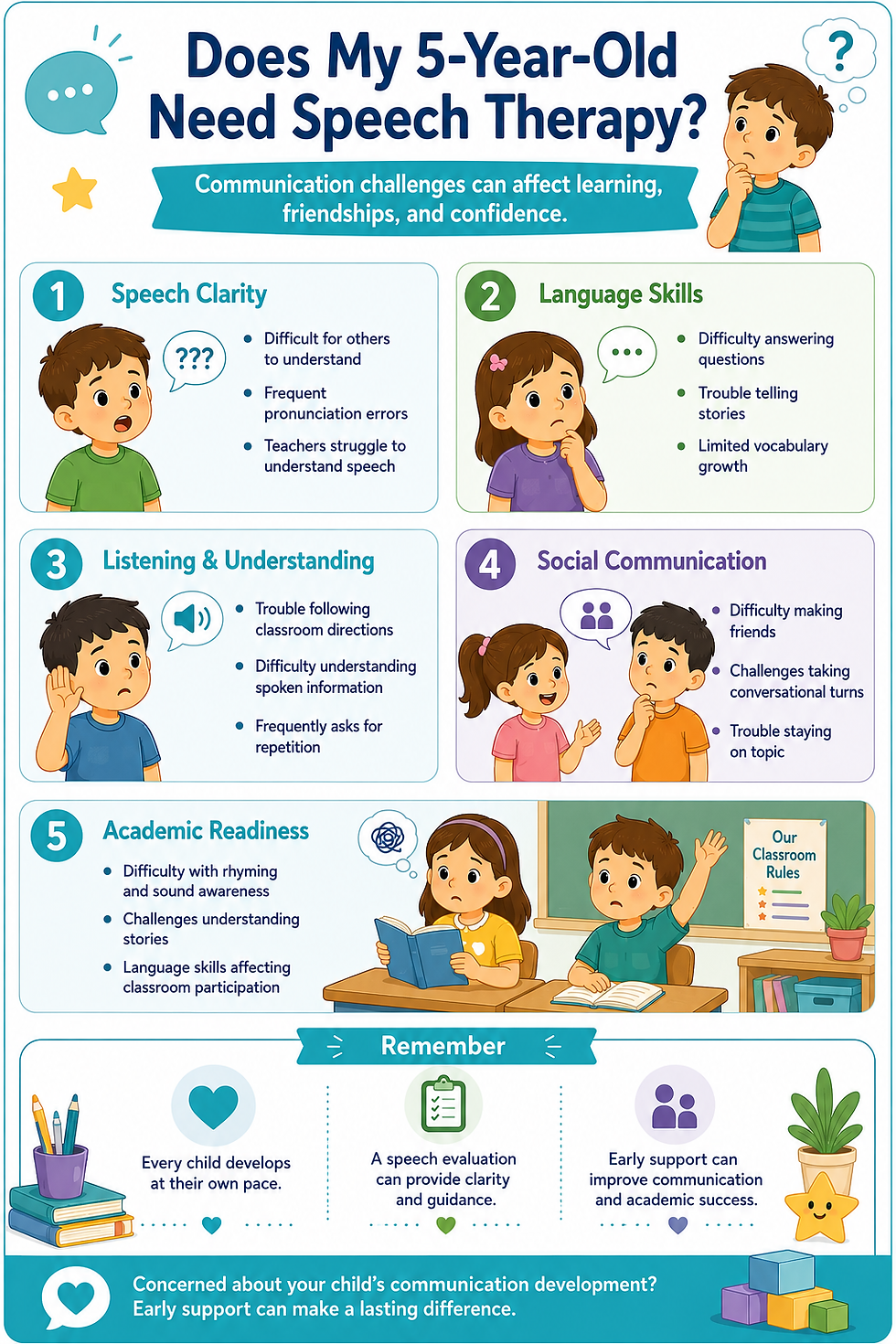
Communication challenges can affect academic performance, friendships, and self-confidence.
Recognizing potential warning signs can help families seek support early.
Difficulty Being Understood
One of the most common reasons parents seek speech therapy is because their child is difficult to understand.
Signs may include:
Teachers frequently asking for clarification
Friends struggling to understand speech
Family members translating for the child
Communication-related frustration
Speech-language pathologists can evaluate speech sound development and identify areas that may benefit from intervention.
Challenges Following Classroom Directions
Many classroom activities require children to understand and follow multi-step instructions.
A child who struggles with directions such as:
"Put your folder away, take out your workbook, and sit on the carpet."
"Finish your drawing and then line up at the door."
may be experiencing receptive language difficulties.
Trouble Answering Questions
Language development involves more than understanding vocabulary.
Some children struggle to answer questions involving:
Who
What
Where
When
Why
How
Difficulty responding appropriately can impact classroom participation and learning.
Difficulty Telling Stories
Storytelling is an important communication skill at this age.
Children may struggle to:
Organize ideas
Sequence events
Provide details
Explain experiences clearly
Speech therapy can help children strengthen narrative language skills that support both communication and literacy development.
Social Communication Challenges
Communication is also essential for building relationships.
Some children have difficulty:
Taking turns during conversations
Understanding social cues
Maintaining topics
Joining peer interactions
Resolving conflicts through language
These social communication skills become increasingly important during the early school years.
Reading and Language Concerns
Speech and language development are closely connected to literacy skills.
Children who struggle with language may also experience challenges with:
Rhyming
Sound awareness
Vocabulary
Story comprehension
Early reading skills
For example, some children with hyperlexia demonstrate advanced reading abilities while experiencing difficulties with language comprehension and social communication.
Understanding these unique developmental profiles helps therapists provide individualized support.
What Does Speech Therapy Help With at Age 5?
Speech therapy addresses a wide range of communication challenges that may affect academic, social, and emotional development.
Because every child is different, treatment plans are tailored to individual needs and goals.
Speech Sound Disorders
Some children know exactly what they want to say but have difficulty producing speech sounds clearly.
Speech therapy may help improve:
Articulation
Pronunciation
Speech clarity
Overall intelligibility
The goal is to help children communicate effectively in all environments, including school and social settings.
Expressive Language Delays
Expressive language refers to how children communicate their thoughts, ideas, and experiences.
Speech therapy may help children:
Expand vocabulary
Build longer sentences
Answer questions more effectively
Tell stories
Explain ideas clearly
Participate in classroom discussions
Receptive Language Delays
Receptive language refers to a child's ability to understand spoken language.
At age 5, receptive language skills become increasingly important because children are expected to follow classroom instructions, understand stories, and process more complex information.
Speech therapy may help children improve their ability to:
Follow multi-step directions
Understand questions
Learn new vocabulary
Comprehend stories and conversations
Process spoken information more efficiently
Strong receptive language skills support academic learning and social interactions.
Social Communication Skills
Many children receiving speech therapy need support developing social communication skills.
These skills help children navigate friendships, classroom interactions, and everyday conversations.
Speech-language pathologists may help children learn how to:
Start conversations
Maintain topics
Take conversational turns
Understand body language and facial expressions
Interpret social cues
Solve social problems
Participate in group activities
Strong social communication skills help children build meaningful relationships and succeed in collaborative learning environments.
Literacy and Language Development
Speech and language skills form the foundation for reading and writing success.
Many speech therapy goals at age 5 support literacy development through activities that target:
Vocabulary growth
Listening comprehension
Storytelling
Rhyming
Sound awareness
Sequencing skills
Children who struggle with language development may also experience challenges related to reading readiness and comprehension.
Some children may demonstrate communication profiles such as hyperlexia, which involves advanced reading abilities alongside differences in language comprehension or social communication.
Understanding these patterns helps therapists create individualized intervention plans.

Autism-Related Communication Challenges
Some 5-year-olds receiving speech therapy may also be autistic.
Communication differences associated with autism vary widely and can affect:
Social communication
Conversational skills
Language comprehension
Emotional expression
Peer interactions
Flexible communication
Families seeking specialized support can learn more about online speech therapy for kids with autism.
Some autistic children also develop language through Gestalt Language Processing, a language-learning style in which children acquire larger chunks of language before analyzing them into smaller components.
Recognizing these communication styles allows therapists to create more effective and individualized treatment approaches.
What Happens During a Speech and Language Evaluation?
Many parents feel uncertain about what to expect during their child's first speech evaluation.
Fortunately, evaluations are designed to be child-friendly, engaging, and informative.
The goal is to understand a child's strengths, challenges, and communication needs.
Parent Interview
The evaluation typically begins with a discussion between the speech-language pathologist and the caregiver.
Topics may include:
Developmental history
Medical history
Academic concerns
Social communication skills
Family observations
Current challenges
Parents provide valuable information that helps guide the assessment process.
Speech Assessment
If speech clarity is a concern, the therapist may assess:
Articulation
Speech sound production
Pronunciation patterns
Overall intelligibility
This helps determine whether speech sound errors are developmentally appropriate or require intervention.
Language Assessment
The therapist may evaluate both receptive and expressive language skills.
Areas assessed often include:
Vocabulary
Sentence structure
Understanding language
Answering questions
Storytelling
Following directions
Social Communication Assessment
Because communication extends beyond speech, therapists may also observe:
Conversation skills
Social interaction
Turn-taking
Nonverbal communication
Peer communication abilities
Goal Development
After completing the evaluation, the therapist develops a personalized treatment plan.
Goals are based on the child's unique strengths, challenges, and developmental needs.
Families seeking additional guidance can also explore Sounderic's resource on does your child need speech therapy? to better understand the evaluation process.
What Does Speech Therapy Look Like for a 5-Year-Old?
Speech therapy for 5-year-olds often becomes more structured than therapy for younger children while still remaining engaging and interactive.
Sessions are designed to support school-age communication demands while keeping children motivated and confident.
Structured Play Activities
Even though 5-year-olds can participate in more structured learning tasks, play remains an important teaching tool.
Therapists may use:
Board games
Interactive activities
Problem-solving tasks
Role-playing exercises
Story-based activities
These activities create meaningful opportunities to practice communication skills.
Speech Sound Practice
Children working on articulation goals may participate in activities targeting:
Individual speech sounds
Word production
Sentence production
Conversational speech
Practice is designed to help children transfer skills from therapy into everyday communication.
Conversation Skills
Conversation skills become increasingly important at this age.
Therapy may focus on:
Starting conversations
Staying on topic
Asking questions
Listening to others
Taking conversational turns
These abilities help children participate more successfully in both academic and social settings.
Storytelling Activities
Narrative language is a major focus for many 5-year-olds.
Children may practice:
Retelling stories
Describing experiences
Sequencing events
Explaining ideas
Providing details
Storytelling skills support classroom participation, reading comprehension, and written language development.
Classroom Readiness Tasks
Speech therapy often incorporates activities that mimic classroom expectations.
Examples include:
Following directions
Listening activities
Answering questions
Group discussions
Problem-solving tasks
These activities help prepare children for academic success.
Literacy-Based Activities
Many therapists incorporate literacy-related goals into treatment.
Activities may target:
Rhyming
Sound awareness
Vocabulary development
Story comprehension
Listening skills
These skills support future reading and writing success.
Common Speech Therapy Activities for 5-Year-Olds
Speech therapists use a variety of activities to keep children engaged while targeting specific communication goals.
Story Retelling
Children listen to a story and then retell it using their own words.
This activity helps strengthen:
Narrative skills
Sequencing
Vocabulary
Memory
Language organization
Problem-Solving Discussions
Children may discuss hypothetical situations such as:
"What would you do if you lost your backpack?"
"How would you solve a disagreement with a friend?"
These activities support critical thinking and expressive language development.
Sequencing Activities
Sequencing tasks help children organize information logically.
Examples include:
Ordering picture cards
Explaining routines
Retelling events
Describing steps in a process
These skills are important for both communication and academic success.
Social Skills Practice
Role-playing activities allow children to practice:
Making friends
Joining conversations
Asking for help
Solving conflicts
Understanding perspectives
These experiences help build confidence and social competence.
Reading Readiness Exercises
Speech therapists often incorporate activities that support literacy development.
Examples include:
Rhyming games
Sound matching activities
Vocabulary exercises
Listening comprehension tasks
These skills contribute to future academic success.
Following Directions Games
Many therapy activities involve listening and responding to increasingly complex directions.
Examples include:
Simon Says
Scavenger hunts
Obstacle courses
Classroom-style activities
These games strengthen receptive language and attention skills.
Why Parent Involvement Still Matters
Although 5-year-olds are becoming more independent communicators, parents continue to play a vital role in communication development.
The strategies children learn during therapy are most effective when reinforced consistently at home.
Reinforcing Skills at Home
Parents can support therapy goals by:
Reading together
Encouraging storytelling
Practicing conversations
Playing language-rich games
Following therapist recommendations
Families looking for additional support strategies may find helpful ideas in our guide on how to treat speech delay at home.
Supporting Literacy Development
Parents can help strengthen literacy skills through:
Daily reading
Discussing stories
Playing rhyming games
Encouraging vocabulary growth
Talking about everyday experiences
These activities support both language development and academic readiness.
Encouraging Conversation
Children learn language through meaningful interaction.
Parents can encourage communication by:
Asking open-ended questions
Expanding on children's responses
Encouraging storytelling
Discussing daily experiences
These conversations create valuable opportunities for language growth.
Building Confidence
Perhaps most importantly, parents help children develop confidence in their communication abilities.
Positive communication experiences encourage children to participate, take risks, and continue developing new skills.
How Long Does Speech Therapy Take to Show Results?
One of the most common questions parents ask is, "How long will my child need speech therapy?"
The answer depends on several factors, including the child's communication needs, learning style, therapy goals, and the consistency of practice both during and outside therapy sessions.
Every child's communication journey is unique, and progress often occurs gradually over time.
Factors That Affect Progress
Several factors influence how quickly a child develops communication skills.
Type of Communication Challenge
Children working on articulation errors may progress differently than children with language delays, social communication challenges, or autism-related communication differences.
The nature and complexity of the communication challenge often affect the timeline for improvement.
Consistency of Therapy
Regular attendance allows children to build on previously learned skills and maintain momentum.
Children who consistently participate in therapy often have more opportunities to practice and refine communication skills.
Parent Involvement
Parents play a crucial role in helping children apply new communication skills during everyday activities.
The more opportunities children have to practice communication at home, the more likely they are to generalize those skills across different settings.
Individual Learning Differences
Every child learns differently.
Some children acquire new communication skills quickly, while others benefit from additional repetition and support.
Progress should always be measured based on individual growth rather than comparisons with peers.
Celebrating Small Wins
Communication growth often occurs in small but meaningful steps.
Examples include:
Clearer speech
Improved listening skills
Longer conversations
Better storytelling abilities
Increased classroom participation
Greater confidence when speaking
Stronger peer interactions
These improvements may seem small at first but often represent significant developmental progress.
Every Child's Timeline Is Different
There is no universal timeline for speech therapy success.
The ultimate goal is not perfect communication but effective communication that helps children participate fully in school, friendships, and everyday life.
Can 5-Year-Olds Participate in Online Speech Therapy?
Yes. Many 5-year-olds are excellent candidates for online speech therapy because they can often participate in structured activities, engage in conversations, and follow directions independently.
How Virtual Therapy Works
Online speech therapy sessions are conducted through secure video platforms that allow therapists, children, and caregivers to interact in real time.
Therapists may use:
Interactive digital activities
Online games
Storytelling exercises
Visual supports
Literacy-based activities
Parent-guided exercises
Sessions are individualized to match each child's communication goals.
Benefits of Online Therapy
Comfortable Learning Environment
Children often feel more relaxed and confident when participating from home.
Therapists can incorporate familiar toys, books, and routines into sessions to increase engagement.
Greater Parent Involvement
Virtual sessions make it easier for parents to observe therapy techniques and learn how to support communication development throughout the week.
Access to Specialized Services
Families can connect with experienced speech-language pathologists regardless of location.
This increased access can be especially valuable for families living in areas with limited pediatric speech therapy resources.
Parent Participation Remains Important
Even though 5-year-olds are more independent than younger children, parent involvement continues to play an important role in therapy success.
Speech-language pathologists often coach parents on how to:
Encourage conversations
Support literacy development
Reinforce speech goals
Practice storytelling
Build communication confidence
Families interested in personalized support can learn more about Sounderic's speech therapy for children services.
Is Online Speech Therapy Effective?
Research supports telepractice as an effective method for delivering speech-language services.
According to the American Speech-Language-Hearing Association's telepractice guidelines, virtual speech therapy can achieve outcomes comparable to in-person services when implemented appropriately.
Many school-age children enjoy the flexibility and interactive nature of online therapy.
When Should You Contact a Speech Therapist?
Parents are often unsure whether communication challenges are significant enough to warrant professional support.
While every child develops at their own pace, it's generally beneficial to seek guidance when concerns arise rather than waiting to see if difficulties resolve on their own.
Questions Parents Can Ask Themselves
Consider the following questions:
Is my child's speech difficult to understand?
Does my child struggle to follow directions?
Does my child have difficulty answering questions?
Does my child avoid speaking situations?
Does my child have trouble making friends or participating in conversations?
Is my child experiencing communication-related frustration?
Am I concerned about my child's school performance or readiness?
If several of these concerns apply to your child, a speech-language evaluation may provide valuable insight.
Signs an Evaluation May Be Needed
Parents should consider contacting a speech-language pathologist if their child:
Is frequently misunderstood
Struggles with language development
Has difficulty participating in classroom discussions
Experiences social communication challenges
Has trouble understanding spoken language
Shows signs of reading or language difficulties
Many of these challenges can improve significantly with appropriate intervention and support.
If you're unsure whether professional guidance is necessary, Sounderic's resource on does your child need speech therapy? can help you better understand the signs that may indicate a need for evaluation.
Why Early Support Matters for Academic Success
Communication skills are closely connected to academic achievement.
Strong speech and language skills support:
Reading comprehension
Classroom participation
Writing development
Problem-solving
Social relationships
Self-confidence
Addressing communication challenges early can help children build a stronger foundation for future learning.
Frequently Asked Questions
Should a 5-year-old be understood by everyone?
By age 5, most children should be understood by unfamiliar listeners nearly all the time. If teachers, classmates, or other adults frequently have difficulty understanding your child, a speech-language evaluation may be beneficial.
Can speech therapy help with reading readiness?
Yes. Speech therapy often supports literacy-related skills such as vocabulary development, phonological awareness, listening comprehension, storytelling, and language organization, all of which contribute to reading success.
What speech sounds should a 5-year-old be able to say?
Speech sound development varies among children. Many common speech sounds should be established by age 5, although some later-developing sounds may still be emerging. A speech-language pathologist can determine whether speech sound errors are age-appropriate.
Can speech therapy improve social skills?
Yes. Speech-language pathologists frequently help children develop social communication skills, including conversation, turn-taking, perspective-taking, problem-solving, and peer interaction.
Is online speech therapy effective for 5-year-olds?
Many 5-year-olds do very well in online speech therapy. Virtual sessions can provide engaging, individualized support while allowing parents to participate actively in the therapy process.
How often does a 5-year-old need speech therapy?
The recommended frequency depends on the child's communication needs, goals, and evaluation results. Some children attend therapy once per week, while others benefit from more frequent sessions.
How Can Sounderic Help?
If you're concerned about your 5-year-old's speech, language, literacy, or social communication development, you're not alone.
As children enter kindergarten and the early school years, communication skills become increasingly important for academic success, social relationships, and self-confidence.
At Sounderic, our experienced speech-language pathologists provide personalized, evidence-based therapy designed to help children develop the skills they need to thrive in school and everyday life.
Through engaging online sessions, individualized treatment plans, and parent coaching, we help children strengthen:
Speech clarity and articulation
Language development
Storytelling and narrative skills
Social communication
Listening and comprehension
Literacy-related language skills
School readiness and classroom participation
Whether your child is experiencing a speech delay, language delay, speech sound disorder, or autism-related communication differences, our team works closely with families to create meaningful and lasting progress.
Learn more about our speech therapy for children, explore support options for children with autism, or determine whether an evaluation may be right for your family through our guide on does your child need speech therapy?.
Every child deserves the opportunity to communicate confidently, participate fully, and succeed in school and beyond.


