

Telegraphic Speech in Toddlers: Is It Normal or a Sign of a Speech Delay?


Hearing your toddler say things like "Want cookie," "Mommy go work," or "Doggy run" can be exciting because they're beginning to combine words into short phrases. At the same time, many parents wonder whether leaving out small words such as "the," "is," or "to" is normal—or whether it could be a sign of a speech or language delay.
In many cases, this style of talking is a completely normal stage of language development known as telegraphic speech.
As toddlers begin learning language, they often focus on the most meaningful words in a sentence while leaving out smaller grammar words. This helps them communicate effectively even before they've mastered more complex sentence structures.
According to the American Speech-Language-Hearing Association (ASHA), children gradually progress from single words to combining two or more words as they develop expressive language skills.
However, while telegraphic speech is usually expected during the second year of life, persistent difficulties with combining words, understanding language, or meeting other communication milestones may indicate that a professional evaluation is appropriate.
If you're concerned about your child's communication development, learning more about speech therapy for children can help you understand how early intervention supports language growth.
In this guide, we'll explain what telegraphic speech is, why toddlers use it, when it's considered a normal developmental stage, and when parents should seek professional advice.
What Is Telegraphic Speech?
Telegraphic speech is a stage of language development in which toddlers use short, meaningful phrases that contain the most important words while leaving out smaller grammatical words.
These shorter phrases successfully communicate an idea even though they are not grammatically complete.
For example, instead of saying:
"I want more juice, please."
A toddler might simply say:
"Want juice."
Or instead of saying:
"The baby is sleeping."
They may say:
"Baby sleep."
Although these phrases sound incomplete to adults, they represent an important milestone in expressive language development.
Why Is It Called "Telegraphic" Speech?
The term telegraphic speech comes from the early days of telegrams.
Because people were charged by the word when sending telegrams, they typically included only the most important words while leaving out smaller connecting words.
For example:
Instead of writing:
"I will arrive home tomorrow afternoon."
A telegram might simply say:
"Arrive home tomorrow."
Toddlers communicate in a remarkably similar way.
They naturally prioritize content words—such as nouns, verbs, and adjectives—before mastering grammar words like:
the
is
are
a
an
to
in
on
This pattern is a normal part of learning language and reflects the brain's gradual development of grammar and sentence structure.
Common Examples of Telegraphic Speech
Parents often hear phrases such as:
"Want milk."
"Daddy work."
"More crackers."
"Go park."
"Mommy car."
"Baby sleeping."
"Dog run."
"Me up."
"No bath."
"All done."
Although these phrases are short, they communicate meaningful ideas and show that a child is beginning to combine words intentionally.

Why Do Toddlers Use Telegraphic Speech?
Telegraphic speech isn't something children are taught—it naturally emerges as language develops.
As toddlers' vocabularies grow, they begin combining the words they know into increasingly meaningful phrases.
This stage reflects an important transition from single-word communication to more complete sentences.
Language Develops Gradually
Language development happens in stages.
Most children progress through a sequence similar to this:
Babbling
First words
Single-word communication
Two-word combinations
Telegraphic speech
Longer phrases
Complete sentences
More advanced grammar
Every child develops at their own pace, but this progression provides a general roadmap of expressive language development.
Parents interested in earlier communication milestones can also explore our guide on when babies start talking.
Content Words Come Before Grammar Words
One reason telegraphic speech occurs is that toddlers learn content words before they learn function words.
Content words carry most of the meaning in a sentence.
Examples include:
Mommy
Daddy
Dog
Ball
Eat
Go
Sleep
Cookie
Function words help organize grammar.
Examples include:
the
is
are
was
to
in
on
at
Because content words communicate the main message, toddlers naturally rely on them first.
Over time, grammar develops as their language system becomes more sophisticated.
Brain Development and Language Learning
Learning language involves much more than memorizing words.
Toddlers are simultaneously learning to:
Understand vocabulary
Organize ideas
Build sentences
Learn grammar
Coordinate speech movements
Take turns in conversation
This complex process explains why grammar often develops after vocabulary.
According to the National Institute on Deafness and Other Communication Disorders (NIDCD), children's speech and language skills develop rapidly during the first three years of life as the brain matures and responds to meaningful interaction with caregivers.
At What Age Is Telegraphic Speech Normal?
For most children, telegraphic speech is a typical stage of expressive language development.
The exact timing varies from child to child, but it most commonly appears between 18 months and 3 years of age.
Rather than focusing on a specific birthday, it's more helpful to look at how your child's communication is progressing over time.
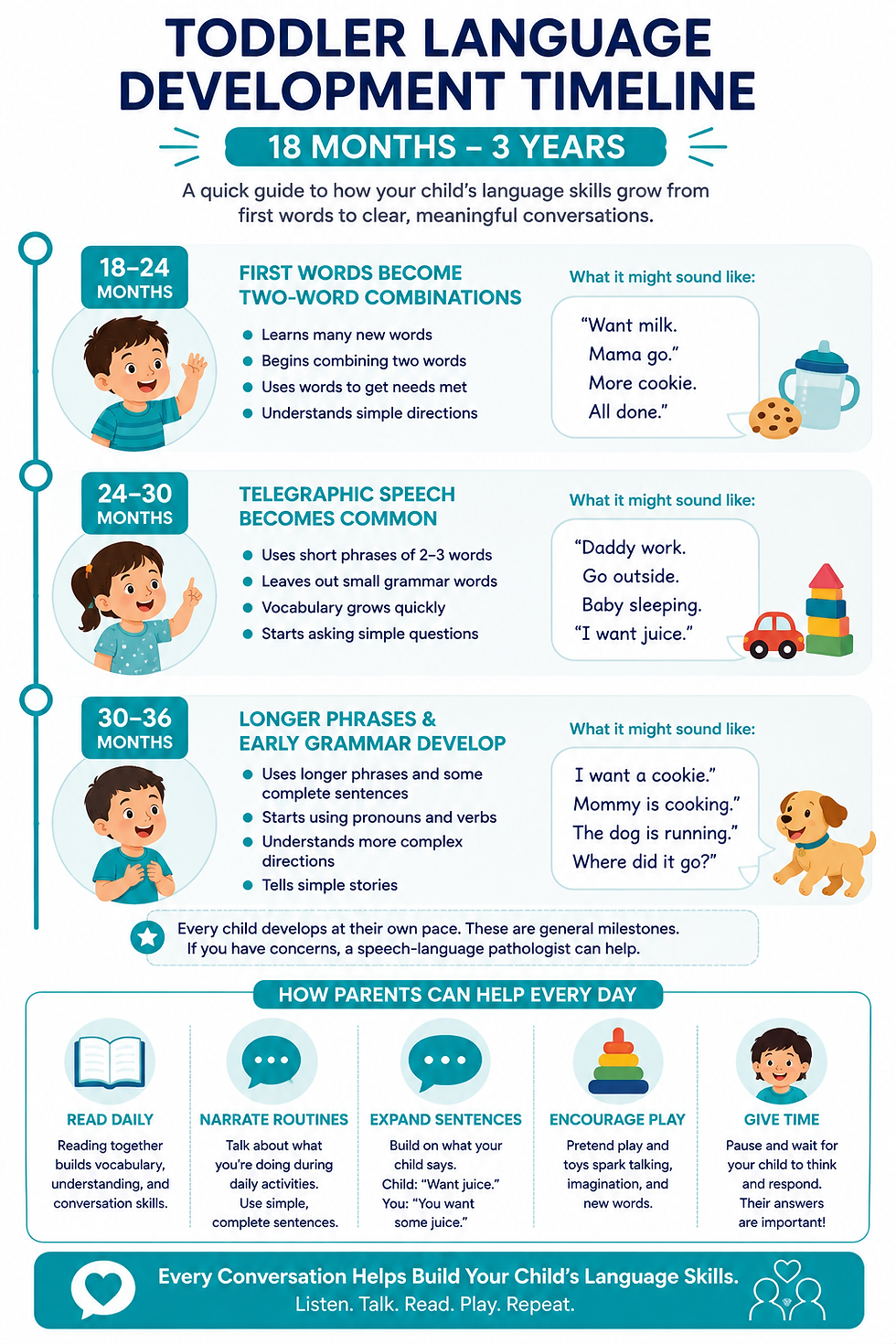
Around 18–24 Months
During the second year of life, many toddlers begin combining two words for the first time.
Examples include:
"More milk."
"Daddy home."
"Baby cry."
"Go outside."
This is an exciting milestone because it shows that children are beginning to understand how words work together to express ideas.
If your child is around this age and has difficulty combining words or uses very few words overall, you may find our guide on how speech therapy works for 2-year-olds helpful.
Between Ages 2 and 3
As vocabulary expands, telegraphic speech typically becomes more complex.
Children often begin using:
Three-word phrases
Early pronouns
Basic verbs
Simple questions
More descriptive language
Examples include:
"Mommy read book."
"I want cookie."
"Daddy go work."
"Baby eating apple."
Many children at this stage are still leaving out smaller grammar words, and that's generally expected.
Parents of preschoolers can also learn what communication milestones to expect in our guide on how speech therapy works for 3-year-olds.
Moving Toward Complete Sentences
By around age 3, many children begin producing longer, more grammatically complete sentences.
Instead of saying:
"Want cookie."
They may begin saying:
"I want a cookie."
Or instead of:
"Daddy work."
They might say:
"Daddy is at work."
Grammar continues developing throughout the preschool years, so occasional grammatical mistakes remain completely normal.
Examples of Telegraphic Speech
Telegraphic speech can sound different from one child to another, but the pattern is usually the same: toddlers use the most meaningful words while leaving out smaller grammar words.
Here's how telegraphic speech compares with typical adult speech:
Telegraphic Speech | Complete Sentence |
Want milk | I want some milk. |
Mommy go work | Mommy is going to work. |
Baby sleeping | The baby is sleeping. |
More crackers | I want more crackers. |
Dog run | The dog is running. |
Daddy home | Daddy is home. |
Me up | Pick me up, please. |
No bath | I don't want a bath. |
All done | I'm all done. |
Go outside | I want to go outside. |
Notice that the meaning is usually clear, even though articles, pronouns, auxiliary verbs, and prepositions are missing.
This is why telegraphic speech is considered a language development milestone, not a communication problem by itself.
Telegraphic Speech vs. Speech Delay
One of the biggest concerns parents have is whether telegraphic speech means their child has a speech delay.
The answer is not necessarily.
Many toddlers naturally go through this stage as they learn to combine words. What matters is whether their language skills continue to progress over time and whether they are meeting other developmental milestones.
What's Considered Typical?
Telegraphic speech is generally expected when a toddler:
Combines two or more meaningful words.
Continues learning new words every week.
Understands simple directions.
Uses gestures alongside speech.
Tries to communicate throughout the day.
Gradually begins using longer phrases.
These are encouraging signs that expressive language is developing as expected.
When Might It Indicate a Language Delay?
Telegraphic speech may warrant further evaluation if it is accompanied by other communication concerns.
Some signs to watch for include:
Very limited vocabulary for their age.
Rarely combining two words after age 2.
Difficulty understanding simple instructions.
Little interest in communicating with others.
Limited eye contact or shared attention.
Minimal progress over several months.
Frequent frustration because they cannot express their needs.
Having one of these signs does not automatically mean a child has a speech or language disorder, but it does indicate that a conversation with a speech-language pathologist may be beneficial.
If you're unsure whether your child's communication is developing as expected, our guide on Does Your Child Need Speech Therapy? explains common signs that parents should look for.
Typical Telegraphic Speech vs. Possible Red Flags
The table below can help parents distinguish between a normal stage of language development and signs that may require professional evaluation.
Typical Telegraphic Speech | Possible Red Flags |
Combines two or three meaningful words | Uses only single words after age 2 |
Vocabulary continues growing | Very limited vocabulary growth |
Understands familiar instructions | Frequently doesn't understand simple directions |
Tries to communicate throughout the day | Rarely initiates communication |
Begins adding new grammar over time | No noticeable progress for several months |
Enjoys interacting with family | Limited social interaction or joint attention |
If your child consistently falls into the second column, an early evaluation can provide valuable guidance. Early intervention is associated with better communication outcomes because support is introduced while language skills are rapidly developing.
How Parents Can Encourage Longer Sentences
The good news is that parents play an important role in helping toddlers move from telegraphic speech to longer, more complete sentences.
The goal isn't to correct every sentence—it is to provide rich language models throughout everyday activities.
Expand Your Child's Sentences
Sentence expansion is one of the most effective language-building strategies.
Instead of asking your child to repeat a sentence correctly, simply build on what they say.
For example:
Child: "Want juice."
Parent: "You want some apple juice."
Child: "Dog run."
Parent: "The dog is running fast!"
This approach gives children a natural model without interrupting communication.
Model Complete Sentences
Children learn language by hearing it repeatedly.
Rather than speaking in simplified phrases yourself, use complete, age-appropriate sentences during daily routines.
For example:
Instead of:
"Shoes on."
Say:
"Let's put your shoes on so we can go outside."
These rich language models help children absorb grammar naturally over time.
Read Together Every Day
Shared book reading exposes children to:
New vocabulary
Longer sentences
Grammar patterns
Story structure
Conversation skills
Pause during reading to ask simple questions such as:
"What do you think happens next?"
"Where is the puppy?"
"What is the girl doing?"
Reading together consistently is one of the strongest ways to support early language development.
Narrate Everyday Activities
Ordinary routines create excellent language-learning opportunities.
Describe what you're doing throughout the day.
Examples include:
"I'm washing the apples."
"You're putting on your blue socks."
"The bubbles are floating in the bath."
"We're cutting the banana into small pieces."
Children hear thousands of meaningful language models through these everyday conversations.
Follow Your Child's Interests
Toddlers learn best when adults talk about what already has their attention.
If your child is fascinated by trucks, animals, bubbles, or dinosaurs, use those interests to introduce new vocabulary and longer phrases.
Responsive interactions are often more effective than directing children toward topics they aren't interested in.
Give Your Child Time to Respond
Many toddlers need a few extra seconds to organize their thoughts before speaking.
After asking a question, pause and wait patiently instead of immediately answering for them.
These brief moments give children valuable opportunities to practice expressive language.
Activities That Support Language Development
Language learning doesn't require flashcards or formal lessons. The most powerful learning experiences happen through play and everyday interactions.
Some simple activities include:
Pretend Play
Kitchen sets, dolls, toy animals, and pretend grocery stores encourage conversation and imaginative language.
Singing Songs
Songs with repetition help children learn vocabulary, rhythm, and sentence patterns in a fun, memorable way.
Daily Conversations
Talk about what you see while driving, shopping, cooking, or walking outside.
Simple comments like "The bird is flying!" or "Look at the big red truck!" expose children to increasingly complex language.
Play-Based Learning
Building blocks, puzzles, sensory bins, and cooperative games naturally create opportunities for requesting, describing, and storytelling.
If you're looking for additional ways to encourage communication at home, our guide on How Can I Treat Speech Delay at Home? shares practical, evidence-informed strategies that families can incorporate into everyday routines.
Myth vs. Fact
Myth: Telegraphic speech always means a speech delay.
Fact: Telegraphic speech is a common stage of language development, particularly between 18 months and 3 years, as children begin combining words.
Myth: I should correct every sentence my toddler says.
Fact: Expanding your child's sentence naturally is generally more effective than asking them to repeat it correctly.
Myth: Children should speak in full sentences as soon as they start talking.
Fact: Language develops gradually. Most toddlers move from single words to two-word combinations, then to telegraphic speech before consistently using complete sentences.
Myth: Waiting to see if my child "grows out of it" is always the best approach.
Fact: While many children progress naturally, persistent communication concerns or missed milestones should be discussed with a speech-language pathologist. Early evaluation can identify whether additional support is needed.
When Should You Be Concerned About Telegraphic Speech?
For many toddlers, telegraphic speech is a healthy and expected stage of language development. As their vocabulary grows and they gain more experience hearing language, they naturally begin adding grammar words and speaking in longer, more complete sentences.
However, if your child's language development doesn't seem to be progressing—or if telegraphic speech is accompanied by other communication difficulties—it may be time to seek professional guidance.
Rather than focusing on a single milestone, it's helpful to consider your child's overall communication skills, including how they understand language, interact with others, and express their needs.
Signs That Your Child May Benefit From a Speech Evaluation
Consider speaking with a speech-language pathologist if your toddler:
Uses very few words for their age.
Is not combining two words by around 24 months.
Continues using only very short phrases with little progress after age 3.
Has difficulty understanding simple instructions.
Rarely initiates communication.
Becomes frustrated because they cannot express themselves.
Shows regression or loses previously acquired language skills.
Has concerns with social communication in addition to language.
Every child develops at their own pace, but persistent delays deserve attention. Early assessment can help determine whether your child is following a typical developmental path or would benefit from additional support.
The Centers for Disease Control and Prevention (CDC) recommends discussing any developmental concerns with your child's healthcare provider rather than waiting to see if they improve on their own. Early identification allows children to access services during a critical period of brain development.
If you're unsure whether your child's communication skills are age-appropriate, our guide on Does Your Child Need Speech Therapy? can help you understand when an evaluation may be beneficial.
How Speech Therapy Helps Children With Language Delays
If a speech-language evaluation identifies a language delay, early intervention can make a meaningful difference.
Speech therapy is not simply about teaching children to say more words. It focuses on helping them understand language, express themselves effectively, and build the communication skills needed for everyday interactions.
Therapy is individualized to each child's strengths, challenges, and developmental goals.
Comprehensive Assessment
A speech-language pathologist begins by evaluating areas such as:
Expressive language
Receptive language
Vocabulary
Sentence development
Play skills
Social communication
Speech sound development
Overall communication milestones
This assessment helps determine whether telegraphic speech reflects typical development or is part of a broader language delay.
Play-Based Therapy
Young children learn best through play.
Speech-language pathologists use engaging activities that encourage children to:
Combine more words.
Expand sentence length.
Learn new vocabulary.
Improve grammar naturally.
Develop conversation skills.
Practice communication in meaningful situations.
Because therapy feels like play, children are often highly motivated to participate.
Parent Coaching
Parents are an essential part of the therapy process.
A speech-language pathologist will teach strategies that can be incorporated into everyday routines, such as:
Expanding your child's utterances.
Modeling complete sentences.
Creating opportunities for communication during play.
Encouraging turn-taking and conversation.
Supporting language during meals, bath time, and outings.
These techniques help children continue learning long after the therapy session ends.
Building Longer, More Complex Sentences
As therapy progresses, children gradually learn to:
Use longer phrases.
Add grammar words naturally.
Ask and answer questions.
Tell simple stories.
Describe events.
Express ideas more clearly.
The goal is to help children communicate confidently across home, school, and social environments.
How Can Sounderic Help?
At Sounderic, we understand that every child's communication journey is unique. While telegraphic speech is often a normal developmental stage, it can sometimes be difficult for parents to know whether their child is progressing as expected.
Our licensed speech-language pathologists provide personalized evaluations and evidence-based therapy designed to support each child's individual needs.
With online speech therapy for children, families can access expert care from the comfort of home while receiving practical coaching to encourage communication during everyday routines.
Whether your child is just beginning to combine words or needs additional support developing longer sentences, we're here to help every step of the way.
Explore our Speech Therapy for Children services to learn how personalized therapy can help your child build confidence and stronger communication skills.
You can also read our related resources:
Conclusion
Telegraphic speech is a natural and important milestone in many toddlers' language development. By using short, meaningful phrases, children demonstrate that they are beginning to understand how words work together to communicate ideas.
For most toddlers, this stage gradually evolves into longer, more grammatically complete sentences as their vocabulary, language comprehension, and communication skills continue to grow.
The most important thing isn't whether your child says every sentence perfectly—it's whether they are making steady progress over time.
If you notice persistent difficulties with vocabulary growth, sentence development, or understanding language, seeking guidance from a speech-language pathologist can provide reassurance and, if needed, early support.
With responsive conversations, play-based learning, daily reading, and timely intervention when appropriate, children have many opportunities to strengthen their communication skills and become confident communicators.
Frequently Asked Questions
Is telegraphic speech normal in toddlers?
Yes. Telegraphic speech is a typical stage of language development for many toddlers, especially between 18 months and 3 years of age. During this stage, children combine meaningful words while leaving out smaller grammar words.
At what age should telegraphic speech stop?
Many children begin using more complete sentences by around age 3, although grammar continues developing throughout the preschool years. Every child progresses at their own pace.
Does telegraphic speech mean my child has a speech delay?
Not necessarily. Telegraphic speech alone is usually a normal developmental stage. However, if your child has a limited vocabulary, difficulty understanding language, or shows little progress over time, a speech-language evaluation may be appropriate.
Can telegraphic speech be a sign of autism?
Telegraphic speech by itself is not a sign of autism. However, if it occurs alongside challenges with social communication, limited eye contact, repetitive behaviors, or other developmental concerns, it's important to discuss these observations with your child's healthcare provider or a speech-language pathologist.
How can I help my toddler use longer sentences?
You can encourage language development by expanding your child's phrases, modeling complete sentences, reading together every day, narrating daily activities, engaging in pretend play, and giving your child time to respond during conversations.
Should I correct my child's grammar?
Instead of correcting mistakes directly, it's generally more effective to model the correct sentence naturally. For example, if your child says, "Want juice," you can respond with, "You want some juice," providing a richer language model without interrupting communication.


