

What is Vocal Stimming in ADHD and Autism? Signs & Support

Does your child constantly hum songs, repeat phrases from cartoons, make random sounds, or talk to themselves repeatedly throughout the day? While these behaviors may sometimes seem unusual or distracting, they are often a form of self-regulation known as vocal stimming.
Vocal stimming refers to repetitive sounds, words, noises, or verbal behaviors that help a person manage emotions, sensory input, focus, or excitement. It is commonly seen in individuals with autism spectrum disorder (ASD) and ADHD, although neurotypical individuals may also engage in stimming behaviors occasionally.
For some people, vocal stimming may look like:
Humming repeatedly
Repeating favorite phrases
Making clicking or squealing sounds
Singing the same line over and over
Repeating movie dialogues or questions
These behaviors are often misunderstood as “attention-seeking” or disruptive habits. In reality, vocal stimming usually serves a purpose. It may help calm the nervous system, improve concentration, reduce anxiety, or express emotions.
According to Autism Speaks, self-stimulatory behaviors like stimming are common among autistic individuals and can play an important role in sensory and emotional regulation.
Understanding why vocal stimming happens is important because support should focus on the person’s comfort, communication, and wellbeing — not simply stopping behaviors that may be helping them cope.
In this guide, we’ll explore:
What vocal stimming is
Why it happens in autism and ADHD
Common examples of vocal stimming
Whether it is harmful
Support strategies for parents and caregivers
When professional guidance may help

What is Vocal Stimming?
Vocal stimming is a type of self-stimulatory behavior that involves making repetitive sounds, noises, words, or verbal expressions. The term “stimming” comes from “self-stimulation,” which refers to repetitive actions that help regulate sensory experiences, emotions, attention, or energy levels.
Vocal stimming can be conscious or unconscious, and it may occur during moments of:
Excitement
Anxiety
Stress
Boredom
Happiness
Sensory overload
Concentration
These vocal behaviors are especially common in people with autism spectrum disorder (ASD) and ADHD because both conditions can involve differences in sensory processing, emotional regulation, and attention control.
According to CDC Autism Spectrum Disorder Information, repetitive behaviors and sensory differences are common characteristics associated with autism.
Common Examples of Vocal Stimming
Vocal stimming can appear in many different ways depending on the individual’s age, personality, sensory needs, and developmental profile.
Some common examples include:
Humming repeatedly
Repeating words or phrases
Singing the same song repeatedly
Clicking sounds with the mouth
Whistling
Beatboxing
Repeating questions
Making animal sounds
Grunting or squealing
Talking to oneself repeatedly
Repeating movie or TV dialogues
One common form of vocal stimming is echolalia, where a person repeats words, phrases, or sentences they have heard before. Echolalia is frequently observed in autistic children and may serve communication or self-regulation purposes.
Some individuals may also display communication differences associated with autistic speech patterns, including repetitive speech, unusual tone, or scripted language.
Why Does Vocal Stimming Happen?
Vocal stimming is not random behavior. In most cases, it serves a meaningful emotional, sensory, or neurological purpose.
People may vocal stim to:
Feel calm
Stay focused
Express emotions
Manage sensory overload
Reduce anxiety
Create predictability
Stimulate the brain during boredom
Understanding the reason behind the behavior is often more helpful than trying to stop it immediately.
Sensory Regulation
Many autistic and ADHD individuals experience the world differently from a sensory perspective. Sounds, lights, textures, crowds, or even silence can sometimes feel overwhelming or uncomfortable.
Vocal stimming may help regulate sensory input by creating predictable and controllable sounds.
For example:
Humming may create calming auditory feedback
Repeating sounds may block overwhelming background noise
Vocal repetition may help a person feel grounded during sensory overload
This is particularly common in autism because sensory processing differences are a major characteristic of the condition.
Emotional Regulation
Vocal stimming may also help manage emotions such as:
Anxiety
Excitement
Frustration
Stress
Happiness
Some children vocal stim more frequently during emotionally intense situations because the repetitive sounds help soothe the nervous system.
For example:
A child may hum when nervous
Repeat phrases when overwhelmed
Make sounds when excited or happy
Rather than viewing these behaviors as “bad habits,” it is often more helpful to recognize them as coping mechanisms.
Focus and Attention Regulation
In ADHD, vocal stimming is often connected to stimulation-seeking behavior.
The ADHD brain frequently seeks additional sensory or mental stimulation to maintain focus and alertness. Making sounds or repeating phrases may help individuals:
Stay mentally engaged
Improve concentration
Reduce restlessness
Manage boredom
This is why some individuals with ADHD:
Talk constantly
Sing while working
Repeat sounds unconsciously
Make rhythmic noises during tasks
According to CHADD (Children and Adults with Attention-Deficit/Hyperactivity Disorder), ADHD can affect self-regulation, attention, and impulsive behaviors in different ways across individuals.
Self-Expression and Enjoyment
Sometimes vocal stimming simply feels enjoyable.
Certain sounds, tones, rhythms, or repeated phrases may provide comfort, pleasure, or emotional satisfaction. For many neurodivergent individuals, stimming is a natural part of how they experience and interact with the world.
Not all vocal stimming indicates distress or a problem that needs intervention.
In many cases, the behavior is harmless and supportive for emotional wellbeing.
Vocal Stimming in Autism
Vocal stimming is especially common in individuals with autism spectrum disorder (ASD). Many autistic children and adults use repetitive sounds, words, or verbal behaviors as a way to regulate sensory input, emotions, or overwhelming situations.
Autism often involves differences in:
Sensory processing
Communication
Emotional regulation
Social interaction
Because of these differences, vocal stimming can become an important coping and self-soothing mechanism.
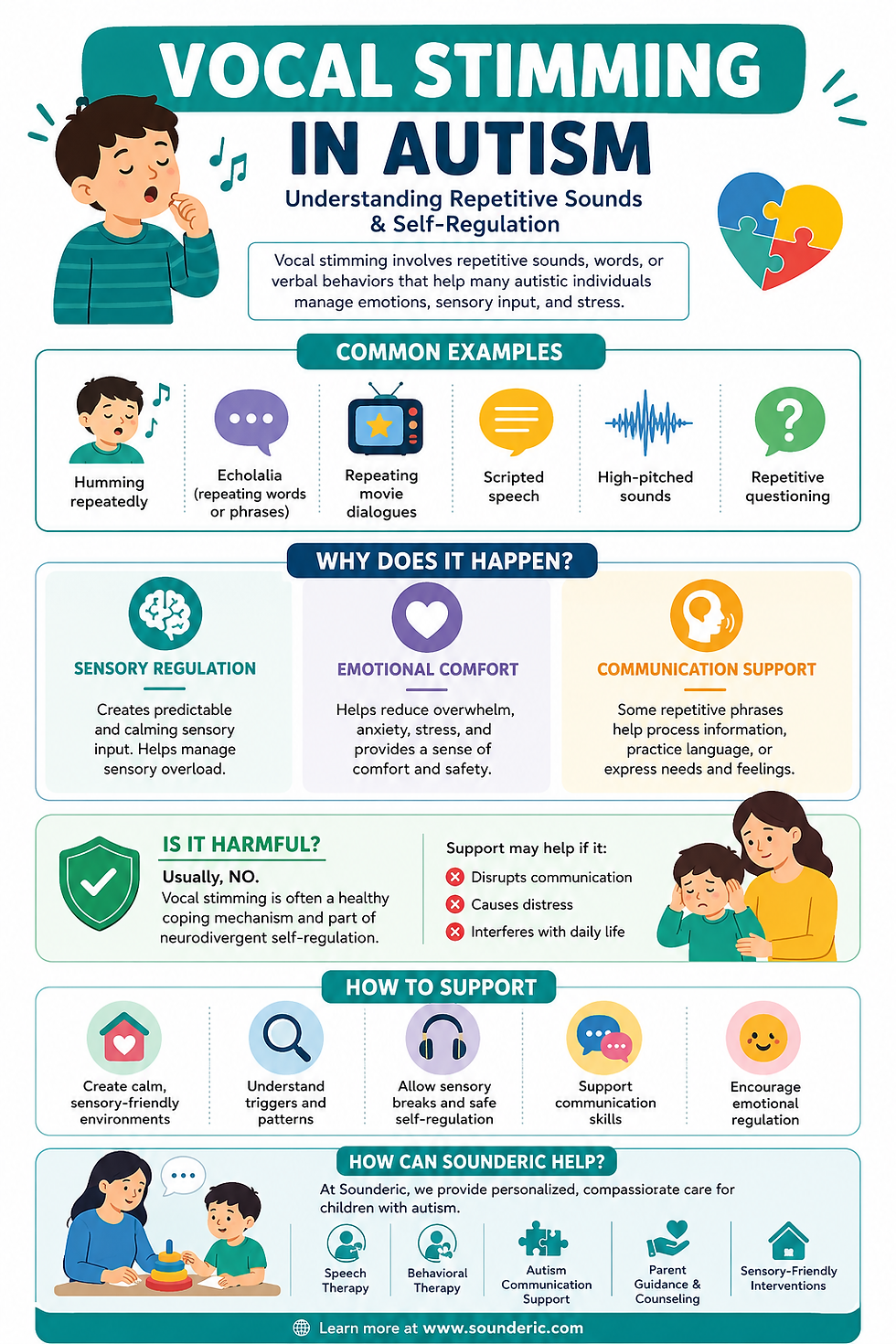
According to CDC Autism Spectrum Disorder Information, repetitive behaviors and sensory-related responses are common characteristics associated with autism.
Why Autistic Individuals Vocal Stim
Autistic individuals may vocal stim for many different reasons, including:
Managing sensory overload
Reducing anxiety or stress
Expressing excitement
Creating predictability
Self-soothing during emotional overwhelm
Communicating needs or emotions
For example:
A child may hum repeatedly in noisy environments
Repeat movie dialogues when excited
Make rhythmic sounds during stressful situations
Use repeated phrases for comfort or familiarity
In many cases, these behaviors help the nervous system feel more regulated and secure.
Common Examples of Vocal Stimming in Autism
Vocal stimming in autism can vary widely from person to person.
Some common examples include:
Repeating phrases from TV shows
Humming continuously
High-pitched squealing sounds
Repeating questions
Scripted speech
Sound imitation
Singing repeatedly
Repetitive verbal noises
One particularly common behavior is echolalia, where an individual repeats words, phrases, or sentences they have heard previously.
Echolalia may serve several purposes, such as:
Practicing language
Processing information
Managing anxiety
Attempting communication
Self-regulation
Many autistic individuals may also display communication differences associated with autistic speech patterns, including repetitive speech, unusual tone, scripted language, or difficulty with conversational flow.
Sensory Overload and Vocal Stimming
Sensory overload is one of the biggest triggers for vocal stimming in autism.
Some autistic individuals experience heightened sensitivity to:
Loud sounds
Bright lights
Crowded environments
Certain textures
Strong smells
During overwhelming situations, vocal stimming may help block external sensory input or create predictable sensory feedback.
For example:
Humming may drown out background noise
Repetitive sounds may create calming auditory patterns
Scripted speech may provide familiarity during stressful situations
Rather than viewing these behaviors negatively, it is important to understand that they often serve an emotional and neurological purpose.
Vocal Stimming in ADHD
Although stimming is most commonly discussed in relation to autism, it is also very common in people with ADHD.
Individuals with ADHD may engage in vocal stimming as a way to:
Stay mentally stimulated
Improve focus
Reduce boredom
Manage hyperactivity
Regulate emotions
The ADHD brain often seeks additional stimulation to maintain attention and alertness. Vocal behaviors can provide the extra sensory input needed to stay engaged.

According to CHADD (Children and Adults with Attention-Deficit/Hyperactivity Disorder), ADHD affects attention regulation, impulsivity, and self-management skills in ways that can contribute to repetitive or stimulation-seeking behaviors.
Common Examples of Vocal Stimming in ADHD
People with ADHD may vocal stim in ways such as:
Constant talking
Random singing
Beatboxing
Repeating sounds
Clicking the tongue
Making rhythmic noises
Talking to themselves
Repeating jokes or phrases
Unlike autism-related stimming, ADHD vocal stimming is often more strongly connected to:
Under-stimulation
Restlessness
Hyperactivity
Maintaining attention
For example:
Someone may hum while concentrating
Repeat sounds during boring tasks
Sing while working or studying
These behaviors may happen unconsciously and are often more noticeable during tasks requiring sustained attention.
ADHD vs Autism Vocal Stimming
While vocal stimming occurs in both ADHD and autism, the reasons behind the behavior may differ slightly.
In Autism:
Vocal stimming is often linked to:
Sensory regulation
Emotional comfort
Predictability
Coping with overwhelm
In ADHD:
Vocal stimming is more commonly associated with:
Seeking stimulation
Maintaining focus
Reducing boredom
Hyperactivity management
However, there is also significant overlap, and some individuals may have both ADHD and autism.
Common Examples of Vocal Stimming
Vocal stimming can look different depending on the individual’s age, sensory profile, emotions, and environment.
Here are some of the most common vocal stimming behaviors seen in children and adults:
Humming repeatedly
Repeating words or phrases
Singing lines from songs over and over
Whistling
Clicking noises
Grunting or squealing
Beatboxing
Repetitive questioning
Talking to oneself
Scripted speech
Sound imitation
Repeating movie dialogues
Animal sounds
Repetitive laughter or vocal noises
Some individuals vocal stim only occasionally, while others may do it frequently throughout the day.
The intensity of vocal stimming may increase during:
Anxiety
Excitement
Stress
Sensory overload
Boredom
Emotional overwhelm
Understanding the context behind the behavior is often more important than the behavior itself.
Is Vocal Stimming Harmful?
In most cases, vocal stimming is not harmful.
For many autistic and ADHD individuals, it is a healthy coping mechanism that supports:
Emotional regulation
Sensory processing
Focus
Comfort
Self-expression
Trying to completely suppress harmless stimming behaviors may sometimes increase:
Anxiety
Stress
Emotional dysregulation
Frustration
This is why many neurodiversity-affirming professionals encourage understanding and support rather than punishment or forced suppression.
When Vocal Stimming May Become Concerning
Although vocal stimming itself is usually harmless, support may be helpful if the behavior:
Interferes with learning
Prevents communication
Causes distress
Leads to social isolation
Disrupts daily functioning
Becomes extremely intense or uncontrollable
In such situations, the goal should not be to “eliminate” stimming entirely. Instead, support strategies should focus on:
Understanding triggers
Improving regulation skills
Supporting communication
Creating healthier coping mechanisms
Parents concerned about communication development may also benefit from learning more about speech delay in children and related developmental signs.
How to Support Someone with Vocal Stimming
Supporting someone with vocal stimming begins with understanding that these behaviors often serve an important emotional, sensory, or neurological purpose.
Instead of immediately trying to stop the behavior, it is more helpful to identify why it is happening and how the person is using it to self-regulate.
A supportive and compassionate approach can help children and adults feel safe, understood, and emotionally secure.
Identify Triggers
The first step is observing when vocal stimming increases.
Some common triggers include:
Sensory overload
Anxiety or stress
Excitement
Boredom
Fatigue
Frustration
Changes in routine
Parents and caregivers may notice that a child vocal stims more frequently:
In crowded places
During transitions
While completing difficult tasks
During emotional overwhelm
Recognizing patterns can help identify whether the behavior is serving a calming, stimulating, or communication-related purpose.
Create Calm and Safe Environments
For many autistic and ADHD individuals, overwhelming environments can increase the need for stimming.
Helpful adjustments may include:
Reducing loud background noise
Creating quiet sensory-friendly spaces
Using predictable routines
Allowing sensory breaks
Avoiding overstimulating environments when possible
When individuals feel emotionally safe and regulated, distress-related stimming may naturally decrease.
Teach Alternative Regulation Strategies
In situations where vocal stimming becomes disruptive or distressing, supportive coping strategies may help.
These may include:
Deep breathing exercises
Fidget tools
Sensory toys
Music or headphones
Scheduled movement breaks
Visual schedules
Emotional regulation techniques
The goal is not to completely eliminate stimming, but to help individuals develop multiple ways to regulate emotions and sensory experiences.
Support Communication Development
Some children vocal stim because they struggle to communicate emotions, needs, or sensory discomfort effectively.
Supportive communication strategies may include:
Speech and language therapy
Visual communication tools
Social communication support
Emotional expression activities
Interactive play-based learning
Parents who notice communication delays alongside vocal stimming may also find it useful to learn more about speech delay in children and related developmental signs.
According to ASHA (American Speech-Language-Hearing Association), communication-focused interventions can help individuals improve language, social interaction, and emotional expression skills.
Should Vocal Stimming Be Stopped?
One of the most common concerns parents have is whether vocal stimming should be stopped completely.
In most cases, the answer is no.
Vocal stimming is often a natural and healthy self-regulation behavior. Trying to suppress it entirely may increase:
Anxiety
Stress
Emotional dysregulation
Frustration
Sensory discomfort
Instead of focusing only on stopping the behavior, it is usually more beneficial to:
Understand the reason behind it
Identify triggers
Support emotional regulation
Improve communication skills
Teach additional coping strategies when necessary
When Intervention May Help
Support or intervention may be useful if vocal stimming:
Interferes with learning
Prevents communication
Causes emotional distress
Disrupts daily functioning
Leads to social isolation
Becomes physically harmful
Even in these situations, the focus should remain supportive rather than punitive.
A neurodiversity-affirming approach recognizes that stimming is often part of how autistic and ADHD individuals process the world around them.
When to Seek Professional Help
Parents or caregivers may consider professional guidance if vocal stimming is accompanied by :
Delayed speech or communication
Difficulty with social interaction
Extreme sensory sensitivities
Emotional regulation challenges
Signs of autism or ADHD
Difficulty functioning in school or daily life
Early support can help children strengthen:
Communication skills
Emotional regulation
Social interaction
Adaptive coping strategies
Professionals who may help include:
Speech-language therapists
Behavioral therapists
Occupational therapists
Developmental pediatricians
Child psychologists
Parents exploring autism-related developmental concerns may also find useful information in Top Questions Parents Ask About Autism.
How Can Sounderic Help?
Understanding vocal stimming can sometimes feel confusing or overwhelming for parents, especially when it appears alongside communication difficulties, sensory sensitivities, ADHD, or autism-related behaviors. Early support and the right therapeutic guidance can help children develop stronger communication, emotional regulation, and social interaction skills while respecting their individual needs.
At Sounderic, we provide personalized therapy and developmental support programs designed to help children thrive in a supportive, neurodiversity-affirming environment.
Our team works closely with families to understand each child’s:
Communication style
Sensory needs
Behavioral patterns
Emotional challenges
Developmental strengths
Depending on the child’s needs, support may include:
Speech and language therapy
Behavioral therapy
Social communication support
Emotional regulation strategies
Parent guidance and counseling
Sensory-friendly developmental interventions
Children who engage in vocal stimming often benefit from structured and compassionate approaches that focus on communication, confidence, and emotional wellbeing rather than forcing behavioral suppression.
Every child experiences the world differently. With understanding, patience, and the right support system, children with vocal stimming behaviors can continue to learn, communicate, and thrive confidently.
FAQs About Vocal Stimming
What is vocal stimming?
Vocal stimming refers to repetitive sounds, words, or verbal behaviors used for self-regulation, sensory processing, emotional comfort, or focus. Examples include humming, repeating phrases, singing repeatedly, or making rhythmic noises.
Is vocal stimming a sign of autism?
Vocal stimming is common in autism, but not everyone who vocal stims is autistic. It can also occur in individuals with ADHD or even neurotypical individuals during stress, excitement, or concentration.
Can people with ADHD vocal stim?
Yes. People with ADHD may vocal stim to improve focus, reduce boredom, manage hyperactivity, or increase mental stimulation.
Is vocal stimming harmful?
Usually, vocal stimming is not harmful. It often serves as a coping or self-regulation mechanism. Support may be helpful if the behavior significantly interferes with communication, learning, or daily functioning.
Should parents stop vocal stimming?
Not necessarily. Instead of immediately trying to stop vocal stimming, it is usually more helpful to understand why it is happening and support healthier emotional and sensory regulation strategies.
What therapies help with vocal stimming?
Speech therapy, behavioral therapy, occupational therapy, and sensory regulation strategies can help improve communication, emotional regulation, and coping skills when needed.


