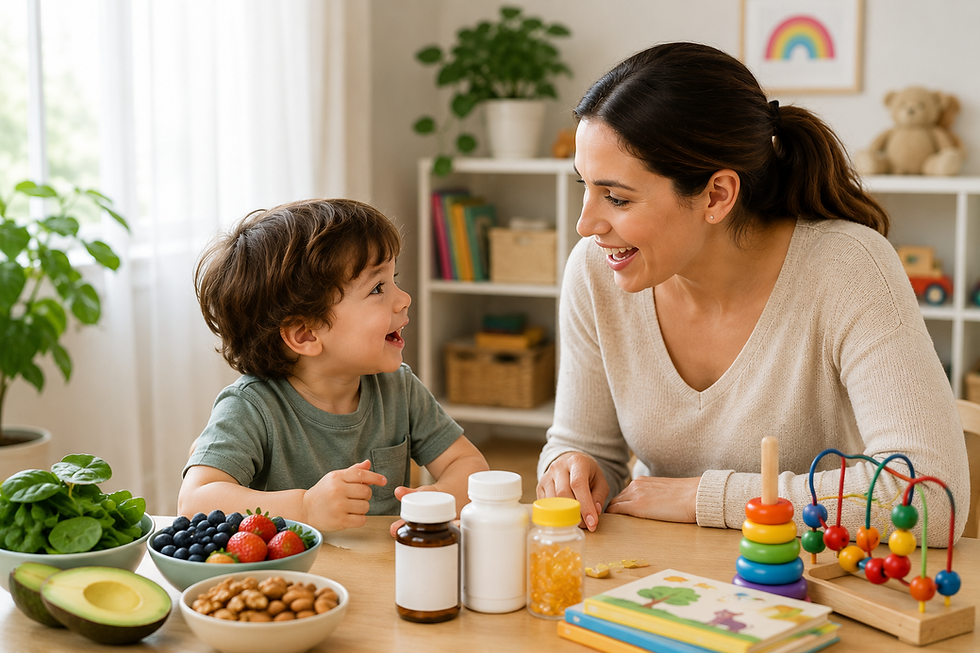
When Do Babies Start Talking? A Detailed Timeline

Updated: May 15
Parents eagerly wait for one magical moment during their baby’s early years — hearing their first word. Whether it’s “mama,” “dada,” or even a cute attempt at naming a favorite toy, a baby’s first words are exciting milestones for every family.
But one question worries many parents:
“When do babies start talking?”
The truth is that every child develops differently. Some babies begin saying words before their first birthday, while others may take a little longer. In many cases, both situations are completely normal.
What’s important to understand is that speech development begins long before babies actually start speaking. Communication starts from birth through:
Crying
Eye contact
Facial expressions
Gestures
Cooing
Babbling
These early communication behaviors help babies gradually build language and speech skills.
Understanding speech milestones can help parents:
Track healthy development
Encourage communication growth
Recognize possible speech delays
Know when professional guidance may help
In this detailed guide, we’ll cover:
When babies usually start talking
A month-by-month speech development timeline
Common speech milestones
Signs of delayed speech
Ways parents can encourage language growth
When to consider speech therapy support

Understanding Baby Speech Development
Before babies say actual words, they spend months learning how communication works.
Speech development is a gradual process involving:
Listening
Observing
Understanding sounds
Recognizing emotions
Practicing vocal movements
Responding socially
Speech Starts Before First Words
Many parents think speech begins when babies say “mama” or “dada,” but communication actually begins at birth.
Newborn babies communicate through:
Crying
Body movements
Eye contact
Facial expressions
Different vocal sounds
As babies grow, they slowly begin understanding that sounds and words carry meaning.
For example:
A newborn may cry differently when hungry or uncomfortable.
A 4-month-old may laugh or squeal excitedly.
A 9-month-old may babble repeatedly to gain attention.
These are all early communication milestones.
According to the CDC developmental milestones guide, communication skills begin developing during infancy and grow rapidly during the first few years of life.

Speech vs Language: What’s the Difference?
Parents often use “speech” and “language” interchangeably, but they are slightly different.
Speech
Speech refers to producing sounds and words.
This includes:
Pronunciation
Sound production
Voice quality
Articulation
Fluency
Language
Language refers to understanding and using communication meaningfully.
This includes:
Understanding words
Gestures
Following instructions
Vocabulary
Expressing ideas
Social communication
A baby may understand many words before they can actually say them.
For example, a 10-month-old may:
Respond to their name
Understand “bye-bye”
Recognize familiar objects
Follow simple directions
Even without speaking much, language development is still progressing.
Why Babies Develop Speech at Different Speeds
Every baby develops differently, and speech milestones can vary.
Several factors influence language development:
1. Genetics
Children may inherit developmental patterns from family members.
2. Environment
Babies exposed to frequent conversation, reading, singing, and interaction often develop language skills faster.
3. Hearing Ability
Hearing plays a major role in speech development because babies learn language by listening.
4. Personality
Some babies are naturally quiet observers, while others are highly vocal.
5. Premature Birth
Premature babies may sometimes reach milestones slightly later.
6. Bilingual Exposure
Learning multiple languages does not confuse babies. In fact, bilingual exposure can be beneficial for cognitive development.
The American Speech-Language-Hearing Association (ASHA) explains that developmental timelines can vary while still remaining within healthy ranges.
Baby Talking Timeline by Age
Understanding speech milestones by age can help parents know what to expect during each stage of development.
Birth to 3 Months — Early Communication Begins
Although newborn babies cannot speak yet, they are already learning communication skills from birth.
At this stage, babies mainly communicate through crying, facial expressions, and body movements.
Common Communication Milestones
Between birth and 3 months, babies often:
Cry differently for different needs
Recognize parents’ voices
Become calmer when spoken to
Make cooing sounds
Smile socially
Respond to sounds
Watch faces carefully
Parents may notice babies reacting differently to familiar versus unfamiliar voices.
For example:
Quieting when hearing a parent’s voice
Turning toward sounds
Smiling during interaction
These behaviors help build listening and social communication skills.
What Is Cooing?
Cooing is one of the earliest speech-like behaviors in babies.
Common cooing sounds include:
“ooo”
“aaa”
“goo”
Cooing usually begins around 6 to 8 weeks of age.
This stage is important because babies are:
Experimenting with vocal sounds
Learning sound control
Responding socially
When caregivers respond positively to cooing, babies learn that communication creates interaction.
How Parents Can Support Communication at This Stage
Talk Frequently
Describe daily routines naturally.
Example:
“We are changing your clothes.”
“Now it’s feeding time.”
Maintain Eye Contact
Babies learn communication through facial engagement.
Respond to Sounds
When babies coo or make noises, respond enthusiastically.
Sing Songs
Music helps babies recognize rhythm and speech patterns.
Possible Red Flags Between Birth and 3 Months
Parents may consider discussing concerns with a pediatrician if a baby:
Does not respond to loud sounds
Rarely reacts to voices
Shows limited eye contact
Rarely vocalizes
Hearing concerns are especially important because hearing strongly affects speech development.
The Healthy Children guide by the American Academy of Pediatrics emphasizes monitoring early communication milestones carefully.
4 to 6 Months — Babbling Begins
Between 4 and 6 months, babies become much more vocal and interactive.
This stage is exciting because babies begin experimenting intentionally with sounds.
Common Speech Milestones at 4 to 6 Months
During this stage, babies often:
Laugh frequently
Squeal excitedly
Respond to playful voices
Babble repeatedly
Make consonant sounds
Vocalize during interaction
Babbling may include:
“ba”
“ma”
“da”
“ga”
Although these sounds resemble words, babies usually do not attach meaning to them yet.
Why Babbling Is Important
Babbling is one of the most important speech milestones because it helps babies:
Strengthen mouth muscles
Practice sound production
Learn speech rhythm
Coordinate breathing and vocalization
Experiment with communication
Babies also begin learning conversational patterns.
For example:
Parent talks
Baby babbles
Parent responds
Baby vocalizes again
This back-and-forth interaction teaches the basics of communication.
Research published through the National Center for Biotechnology Information (NCBI) explains that early vocal interactions are essential for language acquisition and cognitive development.
How Parents Can Encourage Babbling
Repeat Sounds Back
If your baby says “ba-ba,” repeat it enthusiastically.
Use Expressive Facial Reactions
Babies learn social communication through emotional responses.
Read Simple Picture Books
Hearing repeated language helps vocabulary growth later.
Reduce Excessive Passive Screen Time
Human interaction supports speech development far more effectively than passive screen exposure.
A research review published on PubMed Central (PMC) found associations between excessive passive screen time and language development concerns in young children.
Possible Red Flags Between 4 and 6 Months
Parents may consider professional guidance if their baby:
Rarely vocalizes
Does not laugh or squeal
Shows little interest in interaction
Does not respond consistently to sounds
In some cases, early evaluation may help identify hearing or communication concerns.
Families seeking guidance about communication development can explore resources related to speech therapy for children and early intervention support.
7 to 9 Months — Understanding Language Begins
Between 7 and 9 months, babies become increasingly social and interactive. Although many babies are still not speaking meaningful words yet, they are rapidly learning how communication works.
This stage is important because babies begin understanding that words, sounds, and gestures all carry meaning.
They also start recognizing familiar routines, voices, and emotional tones much more clearly.
Common Language Milestones at 7 to 9 Months
During this stage, many babies begin:
Responding to their own name
Understanding simple words like “no” or “bye-bye”
Recognizing familiar people
Copying sounds and tones
Showing excitement during interaction
Using gestures intentionally
Babbling also becomes more advanced.
Instead of isolated sounds, babies may repeatedly combine syllables such as:
“mamama”
“dadada”
“bababa”
Although these repetitive sounds resemble real words, babies usually still do not attach meaning consistently.
Why Repetitive Babbling Matters
This type of babbling is an important milestone because babies are practicing:
Speech rhythm
Sound repetition
Mouth coordination
Conversational timing
Babies also begin imitating sounds they hear regularly from parents and caregivers.
For example:
A parent says “bye-bye”
Baby attempts a similar sound
Parent responds positively
Baby repeats the behavior
These repeated communication loops help strengthen language learning.
Gestures Become More Important
By 9 months, many babies begin using gestures intentionally.
These may include:
Pointing
Reaching upward to be picked up
Waving
Clapping
Looking toward desired objects
Gestures are extremely important because they show babies understand communication before speaking actual words.
Research from Zero to Three language development resources highlights the important role gestures play in early language learning and social interaction.
How Parents Can Encourage Language Development at This Stage
Name Everyday Objects
Label familiar items frequently.
Example:
“This is your bottle.”
“Where is the ball?”
“Look at the dog.”
2. Read Interactive Books
Books with textures, pictures, and repetition help babies connect words with objects.
Use Gestures Frequently
Wave while saying “bye-bye” or point toward objects while naming them.
Encourage Turn-Taking
Pause during interaction and allow babies to respond with sounds or gestures.
Possible Red Flags Between 7 and 9 Months
Parents may consider seeking guidance if their baby:
Does not babble
Rarely responds to voices
Shows little social interaction
Does not respond to their name
Makes very limited sounds
Persistent communication difficulties may sometimes indicate hearing or developmental concerns.
Parents wanting to understand early communication challenges can explore resources related to speech and language therapy support and child communication development.
10 to 12 Months — First Words Usually Appear
The period between 10 and 12 months is one of the most exciting stages of communication development for parents.
This is when many babies begin saying their first meaningful words.
While not every child speaks before their first birthday, many babies start using simple words consistently during this stage.
Common First Words
Typical first words may include:
Mama
Dada
Bye
Ball
Hi
No
Milk
What matters most is whether babies use the word meaningfully.
For example:
Saying “mama” specifically for their mother
Saying “ball” while pointing toward a ball
These are signs of intentional communication.
Understanding Language Develops Faster Than Speaking
One important thing parents should remember is that babies usually understand far more words than they can actually speak.
A 12-month-old may understand:
Familiar names
Daily routines
Common objects
Emotional tones
Simple instructions
Even if spoken vocabulary is limited, language comprehension may still be developing normally.
The ASHA communication milestones guide explains that receptive language skills often develop earlier than expressive speech.
Communication Behaviors at 10 to 12 Months
Babies during this stage often:
Point toward desired objects
Wave goodbye
Shake their head for “no”
Follow simple commands
Imitate familiar sounds
Use gestures intentionally
Parents may notice babies becoming more socially interactive.
For example:
Looking toward named objects
Bringing toys to caregivers
Responding when called
Participating in simple games
These behaviors indicate growing communication awareness.
How Parents Can Encourage First Words
Talk Throughout the Day
Narrate routines naturally.
Example:
“We are washing hands.”
“Let’s open the door.”
Repeat Important Words Frequently
Babies learn language through repetition.
Use Simple Language
Short and clear phrases are easier for babies to understand.
Celebrate Communication Attempts
Respond positively to sounds, gestures, and word attempts.
Positive reinforcement motivates babies to communicate more.
Possible Red Flags Around 12 Months
Parents may consider consulting a professional if their baby:
Does not use gestures
Does not respond to their name
Rarely attempts communication
Shows limited interaction with caregivers
Does not babble meaningfully
Early communication concerns can sometimes benefit from professional assessment and early intervention.
Parents exploring support options may find information about online speech therapy for children useful for understanding speech and language development support.
12 to 18 Months — Vocabulary Growth Begins
Between 12 and 18 months, many toddlers begin expanding their spoken vocabulary more noticeably.
Although development varies from child to child, this stage often includes rapid learning of new words and stronger understanding of communication.
Average Vocabulary at 12 to 18 Months
Many toddlers during this stage may use:
Around 5 to 20 meaningful words
Familiar object names
Basic requests
Social words
Common vocabulary may include:
Mama
Dada
Milk
Dog
More
Up
Bye
No
Some toddlers may speak much more than this range, while others may still rely heavily on gestures.
Communication Skills at This Stage
Toddlers often begin:
Naming familiar objects
Following simple instructions
Copying adult words
Pointing to body parts
Understanding simple questions
Expressing wants more clearly
Parents may also notice toddlers becoming frustrated when unable to communicate effectively. This is normal because language understanding often develops faster than speaking ability.
Why This Stage Is Important
The 12 to 18 month stage plays a major role in long-term language development.
Toddlers are constantly absorbing words from their environment and learning how communication works socially.
They begin understanding:
That words represent objects and actions
How to gain attention verbally
How to express needs and emotions
Simple conversational patterns
This is why frequent interaction is extremely important during this stage.
Research from the CDC developmental milestones resource shows that responsive communication and interaction strongly support healthy language development.
How Parents Can Encourage Talking Between 12 and 18 Months
Read Picture Books Daily
Books with repetitive words and colorful visuals help toddlers connect words with meaning.
Ask simple questions such as:
“Where is the cat?”
“Can you point to the ball?”
Expand Their Words
If a toddler says:
“Dog”
You can respond with:
“Yes, that’s a big brown dog.”
This teaches sentence structure naturally.
Encourage Choices
Offer simple choices:
“Do you want milk or water?”
This encourages verbal responses.
Reduce Guessing
Instead of immediately reacting to gestures, encourage toddlers to attempt words or sounds first.
Possible Red Flags Between 12 and 18 Months
Parents may consider professional evaluation if a toddler:
Uses very few words
Does not imitate sounds
Struggles to understand simple instructions
Rarely points or gestures
Shows limited social communication
Some children may simply be “late talkers,” but persistent delays can sometimes indicate underlying speech or developmental concerns.
Parents concerned about communication milestones may benefit from learning more about speech delay in children and early language intervention.
18 to 24 Months — The Language Explosion
Between 18 and 24 months, many toddlers experience what experts often call a “language explosion.”
During this stage, vocabulary growth can increase rapidly. Some toddlers may begin learning several new words every week.
This is often one of the biggest communication leaps during early childhood.
Typical Vocabulary at 18 to 24 Months
By age 2, many toddlers may:
Use around 50 or more words
Combine two-word phrases
Ask for objects verbally
Name familiar people and items
Examples of two-word phrases include:
“Want milk”
“Daddy go”
“More juice”
“Big ball”
These combinations are important because they show toddlers are beginning to understand sentence structure.
Communication Skills During This Stage
Toddlers often begin:
Following simple two-step directions
Identifying body parts
Answering simple questions
Using words more intentionally
Expressing emotions verbally
Naming favorite objects
Parents may also notice toddlers trying to imitate conversations and social interactions more frequently.
For example:
Pretending to talk on a phone
Repeating phrases from adults
Asking for attention verbally
These behaviors are signs of growing language comprehension and social communication.
Why Vocabulary Growth Accelerates
Around this age, toddlers experience rapid cognitive development.
Their brains become better at:
Storing vocabulary
Understanding relationships between words
Connecting language with experiences
Observing conversational patterns
Daily exposure to language dramatically affects vocabulary growth during this stage.
According to the Zero to Three early communication resource, responsive interaction and play-based communication strongly support language expansion in toddlers.
Ways Parents Can Encourage Language Growth
Narrate Everyday Activities
Talk through routines naturally.
Example:
“We are putting on shoes.”
“Now we are washing hands.”
Ask Open-Ended Questions
Even if toddlers cannot answer fully, questions encourage communication and thinking.
Example:
“What do you want?”
“Where is your toy?”
Sing Songs and Nursery Rhymes
Rhythm and repetition improve sound recognition and memory.
Play Interactive Games
Games like:
Peek-a-boo
Pretend cooking
Toy naming games
help strengthen communication skills.
Possible Red Flags Between 18 and 24 Months
Parents may consider professional guidance if a toddler:
Uses fewer than 20 words by 18 months
Does not combine two words by age 2
Has difficulty understanding simple language
Rarely communicates needs verbally
Shows limited eye contact or social interaction
In some cases, delayed speech may be associated with:
Hearing issues
Developmental delays
Autism spectrum disorder
Oral-motor difficulties
However, delayed talking alone does not automatically indicate a serious condition.
Families seeking expert support may explore resources related to child speech therapy and communication development for early intervention guidance.
2 to 3 Years — Simple Conversations Begin
Between ages 2 and 3, toddlers typically become much more verbal and socially communicative.
This stage often brings major improvements in:
Vocabulary
Sentence formation
Pronunciation
Social interaction
Parents usually notice dramatic communication growth during this period.
Typical Speech Milestones Between 2 and 3 Years
Many toddlers at this age:
Use 200 to 1000 words
Speak in short sentences
Ask simple questions
Describe objects and actions
Use pronouns like “me” and “mine”
Follow two-step directions
Examples of common sentences:
“I want cookie.”
“Daddy come home.”
“Big truck outside.”
Speech may still contain pronunciation errors, but communication becomes much easier to understand.
Social Communication Skills Develop Rapidly
Toddlers between 2 and 3 years often begin:
Participating in simple conversations
Talking during play
Asking “what” and “where” questions
Naming colors and animals
Expressing emotions verbally
Parents may notice constant talking, repeating, and questioning during this stage.
This is actually a positive sign because repeated language practice strengthens speech development.
Pronunciation Is Still Developing
It is completely normal for many words to sound unclear at this age.
Toddlers may:
Simplify difficult sounds
Leave out syllables
Mispronounce longer words
For example:
“Nana” instead of banana
“Wabbit” instead of rabbit
Most pronunciation skills continue improving gradually over several years.
Parents wanting to understand speech sound development further can explore information related to articulation disorders in children and speech clarity development.
How Parents Can Support Communication at This Stage
Have Real Conversations
Instead of asking only yes-or-no questions, encourage toddlers to use longer responses.
Example:
“What did you see outside?”
“Which toy do you want?”
These conversations help toddlers practice vocabulary and sentence building.
Encourage Storytelling
Ask toddlers to describe:
Their toys
Favorite cartoons
Daily activities
Animals they like
Even simple storytelling improves communication confidence.
Continue Reading Together
Books remain one of the best tools for language development.
Reading helps:
Expand vocabulary
Improve listening skills
Build imagination
Teach sentence patterns
Interactive books with questions and pictures work especially well at this age.
Limit Excessive Passive Screen Time
Direct interaction is still one of the strongest contributors to language growth.
Research published on PubMed Central (PMC) suggests excessive passive screen exposure may negatively affect communication development in young children.
Possible Red Flags Between 2 and 3 Years
Parents may consider speech evaluation if:
Speech is extremely difficult to understand
Toddlers rarely form sentences
Vocabulary growth remains very limited
They struggle to follow instructions
Social communication appears limited
Early support can significantly improve communication outcomes.
The American Academy of Pediatrics language delay guide recommends discussing persistent speech concerns with healthcare professionals as early as possible.
3 to 4 Years — Speech Becomes More Understandable
Between ages 3 and 4, children typically become much more confident communicators.
At this stage, conversations become longer, clearer, and more socially interactive.
Parents often notice that their child can now:
Express thoughts more clearly
Ask many questions
Tell simple stories
Describe experiences
Participate in conversations
Speech becomes understandable to most unfamiliar listeners.
Common Speech and Language Milestones at 3 to 4 Years
Many children at this stage:
Speak in longer sentences
Use basic grammar correctly
Ask “why” questions frequently
Tell short stories
Follow multi-step directions
Understand simple time concepts
Examples of speech at this age:
“I played with my friend today.”
“Why is the sky blue?”
“I want the red toy.”
Children also begin understanding conversational rules such as:
Taking turns while talking
Listening to others
Responding appropriately
Social Communication Improves
By age 4, children usually become much better at:
Expressing emotions verbally
Explaining needs
Participating in pretend play
Making friends through conversation
Communication becomes an important part of social development during this stage.
Children often begin:
Asking endless questions
Creating imaginative stories
Singing songs clearly
Talking about daily experiences
These behaviors are signs of healthy language growth.
Pronunciation May Still Be Developing
Although speech becomes clearer, some sounds may still be difficult for children to pronounce correctly.
Certain sounds like:
“r”
“th”
“l”
“s”
may continue developing over the next few years.
Mild pronunciation errors at this stage are often normal.
However, persistent difficulty producing sounds or being difficult to understand may benefit from professional evaluation.
Parents can explore resources about speech sound and articulation difficulties to better understand speech clarity concerns.
Signs of Speech Delay in Babies and Toddlers
Every child develops at a different pace, but some communication delays may require closer attention.
Speech delays can involve:
Limited vocabulary
Difficulty understanding language
Trouble producing sounds
Delayed social communication
Reduced interaction
Early identification is important because timely intervention often improves outcomes significantly.
Possible Warning Signs by Age
By 12 Months
Parents may consider evaluation if a baby:
Does not babble
Does not use gestures
Rarely responds to sounds or names
Shows little interest in interaction
By 18 Months
Possible concerns include:
Very few spoken words
Limited imitation
Difficulty understanding simple instructions
Reduced social communication
By 2 Years
Parents may consider professional guidance if a toddler:
Does not combine two words
Uses very limited vocabulary
Rarely communicates needs verbally
Struggles to follow directions
By 3 Years
Speech concerns may include:
Speech difficult for others to understand
Limited sentence formation
Difficulty interacting socially
Trouble answering simple questions
Important Reminder for Parents
Not every late talker has a serious developmental issue.
Some children naturally develop speech later than others and eventually catch up without long-term concerns.
However, persistent communication difficulties should not be ignored.
Early evaluation can help:
Identify hearing problems
Detect speech or language disorders
Support social communication development
Improve long-term communication outcomes
According to research published on PubMed Central (PMC), early intervention can significantly improve developmental outcomes in children with communication delays.
What Causes Speech Delays?
Speech delays can happen for many different reasons.
In some cases, delays are temporary and mild. In others, they may be linked to underlying developmental or medical conditions.
Understanding potential causes helps parents seek appropriate support early.
Common Causes of Speech Delay
1. Hearing Problems
Hearing plays a critical role in speech development.
Children who cannot hear sounds clearly may struggle to:
Understand words
Copy sounds
Develop pronunciation skills
Even temporary ear infections can sometimes affect language development.
2. Limited Social Interaction
Babies learn communication primarily through human interaction.
Limited conversation, reduced engagement, or excessive passive screen exposure may affect language growth.
Children benefit most from:
Talking
Reading
Singing
Interactive play
3. Developmental Disorders
Speech delays may sometimes be associated with:
Autism spectrum disorder
Developmental language disorder
Intellectual disabilities
However, delayed speech alone does not automatically indicate these conditions.
Parents seeking information about communication challenges associated with autism can explore resources from Sounderic’s autism support section.
4. Oral-Motor Difficulties
Some children may struggle coordinating the muscles involved in speech production.
This can affect:
Pronunciation
Sound clarity
Feeding skills
Mouth movements
5. Premature Birth
Premature babies may sometimes achieve milestones later than full-term babies, including communication milestones.
Adjusted developmental age is often considered when tracking progress.
6. Family History
Speech and language delays may occasionally run in families.
Children with relatives who had speech delays may have a higher likelihood of delayed speech development themselves.
How Parents Can Encourage Babies to Talk
Parents play one of the most important roles in speech and language development.
Simple daily interactions can strongly support communication growth during infancy and toddlerhood.
Talk Frequently Throughout the Day
One of the easiest ways to support speech development is simply talking to your child regularly.
Describe:
Daily routines
Objects
Actions
Emotions
Surroundings
Example:
“We are washing your hands.”
“Look at the big red ball.”
Frequent exposure to language helps babies connect words with meaning.
Read Books Every Day
Reading is extremely beneficial for language development.
Books help children:
Learn vocabulary
Recognize sounds
Understand sentence patterns
Improve listening skills
Picture books with repetition work especially well for young children.
The Zero to Three language development guide highlights reading and responsive interaction as major contributors to early communication growth.
Respond to Babbling and Sounds
When babies vocalize, respond enthusiastically.
This teaches them:
Communication gets attention
Sounds have meaning
Conversations involve turn-taking
Simple back-and-forth interaction helps build social communication skills naturally.
Sing Songs and Nursery Rhymes
Songs improve:
Sound recognition
Rhythm awareness
Memory
Listening skills
Repetition in songs also helps children learn language patterns more effectively.
Reduce Excessive Screen Time
Children learn language best through real human interaction.
Excessive passive screen exposure may reduce opportunities for meaningful communication and conversation.
Interactive play and face-to-face communication remain far more effective for speech development.
When Should Parents See a Speech Therapist?
Many parents wonder whether their child’s speech development is progressing normally or if professional guidance may be needed.
Because every child develops differently, it can sometimes be difficult to know when speech delays are simply temporary and when they may require evaluation.
In general, parents should trust their instincts. If something about a child’s communication development feels concerning, seeking professional advice early is often beneficial.
Situations That May Require Professional Evaluation
Parents may consider consulting a speech-language professional if a child:
Misses multiple communication milestones
Rarely attempts to communicate
Shows limited eye contact or interaction
Has difficulty understanding language
Struggles to produce sounds clearly
Stops using words they previously learned
Shows frustration during communication
Has feeding or oral-motor difficulties
Speech evaluation may also help when:
A child is difficult to understand compared to peers
Vocabulary growth seems very slow
Communication challenges affect social interaction
Why Early Intervention Matters
Early intervention can make a major difference in communication development.
During infancy and early childhood, the brain develops rapidly. This makes young children especially responsive to communication support and therapy.
Early support may help:
Improve speech clarity
Expand vocabulary
Strengthen language understanding
Build social communication skills
Reduce frustration during communication
Improve school readiness later
Research published on PubMed Central (PMC) highlights that early intervention can significantly improve developmental outcomes in children with communication delays.
What Happens During a Speech Evaluation?
A speech-language professional may assess:
Speech clarity
Vocabulary development
Understanding of language
Social interaction
Play skills
Mouth and tongue movements
Hearing-related concerns
The goal is not simply identifying delays but understanding how to best support communication growth.
Parents wanting to better understand communication assessment and support options can explore speech therapy services for children and child language development resources.
How Speech Therapy Helps Babies and Toddlers
Speech therapy is not only for children with severe speech difficulties. It can also support children who need help developing communication skills more effectively.
Speech therapy focuses on improving:
Communication abilities
Speech clarity
Language understanding
Social interaction
Confidence during communication
Therapy is often designed to feel playful and engaging for young children.
Areas Speech Therapy Can Support
1. Speech Sound Development
Some children may struggle producing certain sounds correctly.
Speech therapy can help improve:
Pronunciation
Sound clarity
Articulation
Mouth coordination
Parents can also learn more about articulation disorders in children and how speech sound difficulties are identified.
2. Language Understanding
Some children may have difficulty:
Following directions
Understanding questions
Learning vocabulary
Processing language
Speech therapy activities can strengthen comprehension skills gradually.
3. Expressive Communication
Therapy may help children:
Use more words
Build sentences
Express feelings and needs
Participate in conversations
4. Social Communication Skills
Communication is not only about speaking words.
Children also learn:
Eye contact
Turn-taking
Conversational timing
Emotional expression
Interactive play
These skills are important for social and emotional development.
5. Feeding and Oral-Motor Skills
Some speech therapists also support children experiencing:
Feeding difficulties
Chewing challenges
Weak oral muscle coordination
These areas can sometimes affect speech production as well.
Common Speech Therapy Techniques for Young Children
Speech therapy for babies and toddlers is usually play-based and interactive.
Activities may include:
Singing songs
Picture naming
Sound imitation games
Storytelling
Interactive play
Parent-child communication exercises
Therapists often involve parents directly because communication support works best when continued at home consistently.
Online Speech Therapy for Children
Today, many families also explore virtual speech therapy options.
Online sessions may offer:
Flexible scheduling
Parent involvement
Home-based learning comfort
Access to specialists remotely
Parents interested in virtual support can explore resources related to online vs in-person speech therapy to understand the benefits and differences.
Common Myths About Baby Talking
There are many myths surrounding speech development, and some can create unnecessary worry or confusion for parents.
Understanding the facts can help families make informed decisions about communication development.
Myth 1: Boys Always Talk Late
Many people believe boys naturally talk much later than girls.
While some boys may develop language slightly later, significant communication delays should never be ignored simply because of gender.
Every child should still be monitored using developmental milestones.
Myth 2: Bilingual Children Become Confused
This is one of the most common misconceptions about language development.
Children can successfully learn multiple languages without causing speech disorders.
Bilingual children may:
Divide vocabulary across languages
Mix words occasionally
Reach some milestones slightly differently
However, bilingual exposure itself does not cause speech delays.
Myth 3: Late Talkers Always Catch Up Naturally
Some late talkers do catch up independently.
However, others may continue struggling with:
Vocabulary
Pronunciation
Language understanding
Social communication
Early evaluation helps identify whether support may be beneficial.
Waiting too long can sometimes delay progress unnecessarily.
Myth 4: Screen Time Helps Babies Learn to Talk
Educational videos cannot replace real human interaction.
Babies learn communication best through:
Face-to-face conversation
Eye contact
Social interaction
Interactive play
Passive screen exposure provides far fewer communication opportunities than real-life engagement.
Research published on PubMed Central (PMC) found links between excessive passive screen exposure and language development concerns in young children.
FAQs About When Babies Start Talking
At What Age Do Babies Usually Start Talking?
Most babies say their first meaningful words around 10 to 12 months of age. However, speech development timelines can vary from child to child.
Is Babbling Considered Talking?
Babbling is not considered true talking, but it is an extremely important pre-speech stage that helps babies practice sounds and communication patterns.
When Should Parents Worry If a Baby Is Not Talking?
Parents may consider professional evaluation if major communication milestones are consistently delayed, especially if a child:
Does not babble
Uses very few words
Does not combine words by age 2
Shows limited social interaction
4. Can Screen Time Delay Speech?
Excessive passive screen time may affect communication development because babies learn language best through real human interaction and conversation.
Does Learning Multiple Languages Confuse Babies?
No. Babies are capable of learning multiple languages successfully, and bilingual exposure does not cause speech disorders.
How Can Sounderic Help?
Every child develops communication skills at their own pace, but early support can make a significant difference when speech or language challenges arise. Whether a child is experiencing delayed talking, unclear speech, difficulty understanding language, or social communication challenges, timely guidance can help improve long-term communication outcomes.
At Sounderic, families can access professional speech therapy support designed to help children strengthen speech, language, and communication skills through engaging and personalized approaches.
Sounderic offers support for:
Speech and language delays
Articulation and pronunciation difficulties
Communication development
Social communication skills
Early intervention support
Parent-guided communication strategies
With a focus on child-friendly and interactive therapy approaches, Sounderic helps parents better understand their child’s communication needs while supporting healthy speech and language development in a comfortable and supportive environment.
Most importantly, remember that communication growth happens every day through talking, reading, singing, playing, and interacting with your child consistently. Combined with the right professional guidance when needed, these everyday moments can help build strong communication skills for life.