Why Is My 2-Year-Old Not Talking?Understanding Communication Milestones

Updated: Sep 11

If your 2-year-old isn't talking but seems to understand everything you say, you may be wondering whether this is simply a late-talking phase or whether your child needs additional support.
You may be asking:
Why is my 2-year-old not talking but understanding everything?
Is it normal for a 2-year-old not to talk?
What if my 2-year-old is not talking but is still babbling?
How many words should a 2-year-old say?
Should a 2-year-old be putting two words together?
Could my child have a speech delay?
Does not talking at age 2 mean autism?
When should I consider speech therapy?
There is no single answer that applies to every child. Children develop communication skills at different rates, and a child who understands language well may have different needs from a child who has difficulty both understanding and expressing language.
However, age 2 is an important period for language development. The American Speech-Language-Hearing Association (ASHA) lists several communication skills that commonly emerge between 19 and 24 months, including using and understanding at least 50 words, combining two or more words, following two-step directions, and using words to ask for help. (asha.org)
The CDC's current 2-year milestones include saying at least two words together, pointing to things in a book when asked, pointing to at least two body parts, and using more gestures than simply waving and pointing. (cdc.gov)
These milestones are not a diagnosis. ASHA emphasizes that children develop uniquely and may reach individual milestones at different times. Its milestones are intended to help parents understand development and recognize when professional guidance may be useful. (asha.org)
So if your 2-year-old isn't talking, you don't need to panic—but you also don't have to ignore the concern or wait indefinitely.
Is It Normal for a 2-Year-Old Not to Talk?
Some children are later to develop spoken language than others. A child may have a smaller vocabulary than their peers and gradually catch up, particularly when their other communication skills are developing well.
But "not talking" can mean very different things.
For one 2-year-old, it might mean:
They have a few words but aren't using many.
They use words inconsistently.
They aren't combining words yet.
They mostly communicate through gestures and sounds.
They understand considerably more than they can say.
For another child, it might mean:
They have no meaningful spoken words.
They rarely babble or vocalize.
They don't use gestures to communicate.
They have difficulty understanding language.
They don't seem interested in communicating with other people.
These situations shouldn't all be treated the same way.
The CDC's current milestone for age 2 includes saying at least two words together, while ASHA's 19–24-month milestones include using and understanding at least 50 different words and putting two or more words together. (cdc.gov; asha.org)
That doesn't mean a child who hasn't reached every skill exactly at age 2 automatically has a disorder. Development doesn't happen on a precise birthday.
However, if your 2-year-old has very limited spoken language, isn't combining words, or is missing several communication skills, it is reasonable to discuss your concerns with your child's pediatrician or a speech-language pathologist.
What Should a 2-Year-Old Be Saying?
There isn't one exact list of words that every 2-year-old should know.
Children's first vocabulary can include words for:
People
Food
Toys
Animals
Body parts
Actions
Familiar places
Everyday routines
For example, a child might use words such as:
Mama
Daddy
Ball
Dog
Milk
More
Up
Go
Eat
Bye
Shoe
Book
The particular words matter less than how your child is using language to communicate.
ASHA's 19–24-month milestones include using and understanding at least 50 different words, although speech may still be unclear. ASHA also expects children in this age range to begin combining two or more words, such as "more water" or "go outside." (asha.org)
The CDC takes a different but complementary approach for its 2-year milestone, emphasizing that children should say at least two words together. (cdc.gov)
This is why it is better to look at your child's overall communication profile rather than using a single vocabulary number as a pass-or-fail test.
Two-Word Combinations Are Important
One of the important developments around age 2 is moving from individual words toward combinations.
For example:
"More."
may gradually become:
"More juice."
Or:
"Mommy."
may become:
"Mommy up."
The grammar doesn't need to be perfect. Early combinations are often short and may sound different from adult speech.
The important development is that the child is beginning to combine words to express a more specific meaning.
ASHA specifically lists two-word combinations as a 19–24-month communication milestone. (asha.org)
Understanding Language Matters Too
Spoken vocabulary is only one part of communication.
A 2-year-old may also demonstrate language development by:
Following simple directions
Following two-step directions
Pointing to familiar objects
Identifying body parts
Understanding familiar questions
Using gestures
Showing objects to caregivers
Asking for help
Participating in simple back-and-forth interactions
ASHA's milestones for 19–24 months include following two-step directions and using words to ask for help. (asha.org)
These skills become particularly important when a child isn't talking because they help professionals understand whether the main difficulty appears to involve expressive language, receptive language, or both.
My 2-Year-Old Isn't Talking but Understands Everything
This is one of the most common concerns parents have—and it is also the largest search opportunity identified in this page's GSC data.
If your 2-year-old seems to understand everything you say but isn't talking much, you may notice that they can:
Follow familiar instructions.
Bring you an object when you ask.
Point to things you name.
Understand daily routines.
Recognize familiar people and objects.
Follow simple requests.
Understand considerably more words than they can say.
This can be encouraging because it shows that your child is processing and understanding language.
But strong understanding does not automatically mean there is no language delay.
Receptive Language vs. Expressive Language
One of the most useful distinctions is between receptive language and expressive language.
Receptive language is what your child understands.
For example, you might say:
"Get your shoes and bring them to Mommy."
Your child understands the instruction and brings their shoes.
Expressive language is how your child communicates their own thoughts, needs, wants, and ideas.
A child may understand the instruction but have difficulty saying:
"I want my shoes."
They might instead point, make a sound, or simply bring the shoes to you.
This difference can occur in children with expressive language difficulties.
A child who understands considerably more than they can express may have strengths in receptive language while needing additional support with expressive communication. A speech-language pathologist can evaluate both areas rather than assuming that good understanding means speech development is automatically on track.
For a deeper explanation of this distinction, Sounderic's resource on developmental expressive language disorder can help explain how children may have difficulty expressing thoughts even when their understanding is stronger.
Is Understanding Everything a Good Sign?
It can be a useful strength, but it shouldn't be the only thing you consider.
Ask yourself:
Does your child understand familiar words?
Do they follow simple directions?
Can they follow some two-step directions?
Do they point to request something?
Do they point to show you something interesting?
Do they bring objects to you?
Do they imitate sounds or actions?
Do they use gestures?
Do they try to get your attention?
Do they attempt to communicate in other ways?
Are they gaining new communication skills over time?
Looking at these behaviors gives you a much more complete picture than asking only, "How many words does my child say?"
My 2-Year-Old Isn't Talking but Is Babbling
Some parents notice that their 2-year-old babble frequently but doesn't use many recognizable words.
Babbling can include strings of sounds such as:
"ba-ba-ba"
"da-da-da"
"ma-ma-ma"
or longer sequences with changing sounds and speech-like intonation.
Babbling is a form of vocal communication, but by around age 2, we also want to look at whether those vocalizations are developing into meaningful words and word combinations.
For example, a child might make a particular sound every time they see a dog. If that sound is used consistently and intentionally, it may represent an early attempt at a word.
ASHA notes that children between 19 and 24 months may still have speech that isn't fully clear, giving examples such as "du" for "shoe" or "dah" for "dog." (asha.org)
So a child doesn't need perfect pronunciation before their communication "counts."
Does Babbling Mean My Child Will Start Talking Soon?
Not necessarily.
Babbling can be an encouraging part of vocal development, but it doesn't allow anyone to predict exactly when a child will begin talking.
Instead, look at the whole communication picture.
A 2-year-old who babbles, points, gestures, understands familiar language, imitates sounds, seeks interaction, and is gradually gaining communication skills has a different profile from a child who rarely vocalizes and also has difficulty understanding or interacting.
If your child is still primarily babbling and has very few or no meaningful words at age 2, discussing your concerns with a pediatrician or SLP can help you understand whether an evaluation would be useful.
Why Is My 2-Year-Old Not Talking?
There isn't one single reason why a 2-year-old may have delayed spoken language.
Some children have an isolated delay in expressive language. Others may have difficulties involving understanding, hearing, speech production, social communication, or broader development.
Possible contributors can include:
Expressive language delay
Receptive-expressive language difficulties
Hearing loss
Speech sound or motor-speech difficulties
Autism or other social communication differences
Broader developmental differences
Neurological or genetic conditions
Prematurity or other medical/developmental factors
Having one of these factors does not automatically explain why a particular child isn't talking. A proper evaluation looks at the child's individual strengths and needs.
This is also why we should avoid assuming that a child isn't talking because they're "shy," "lazy," or simply not interested in speaking.
Speech Delay vs. Language Delay
The terms speech delay and language delay are sometimes used interchangeably, but they don't mean exactly the same thing.
Speech involves producing sounds and spoken words.
Language involves understanding and expressing meaning through words, phrases, sentences, gestures, and other communication systems.
For example, a child may understand language and know many words but have difficulty producing particular speech sounds.
Another child may be able to pronounce sounds clearly but have difficulty understanding questions or forming sentences.
A child can also have difficulties in both areas.
Sounderic's guide to speech delay vs. language delay provides a more detailed explanation of this distinction.
For a 2-year-old who isn't talking, understanding which part of communication is affected is much more useful than simply applying the label "speech delay."
What Causes Speech Delay in a 2-Year-Old?
When a 2-year-old isn't talking as expected, parents often want to know exactly what is causing the delay. In reality, there can be several possible explanations, and sometimes more than one factor is involved.
A child may have difficulty primarily with expressive language, while another may have challenges with both understanding and expressing language. Others may have hearing differences, speech-production difficulties, social communication differences, or broader developmental needs.
An evaluation is therefore more useful than trying to determine the cause from a list of symptoms alone.
Expressive Language Delay
Some children understand language relatively well but have difficulty using words to express themselves.
You might notice that your child:
Understands many everyday instructions.
Points to objects when you name them.
Knows what they want but doesn't have the words to express it.
Uses gestures instead of words.
Has a small spoken vocabulary.
Isn't combining words yet.
This can be consistent with a delay primarily affecting expressive language.
The distinction between understanding and expressing language is particularly important when a parent says, "My child understands everything but doesn't talk."
Receptive-Expressive Language Difficulties
Other children have difficulty both understanding language and expressing themselves.
They may struggle with:
Following directions
Understanding questions
Identifying familiar objects
Learning new words
Combining words
Expressing wants and needs
Understanding concepts
Communicating ideas
When both receptive and expressive language appear affected, a comprehensive assessment can help determine which areas need support.
Hearing Loss
Hearing plays an important role in speech and language development.
A child doesn't necessarily need to have obvious hearing loss for hearing to be worth checking. Some children may have fluctuating or partial hearing difficulties and still respond to loud sounds or familiar voices.
You may want to discuss a hearing assessment if your child:
Doesn't consistently respond to their name.
Doesn't seem to notice speech from a distance.
Frequently misunderstands verbal instructions.
Has had repeated ear infections.
Seems to hear some sounds but not others.
Has stopped responding to sounds they previously noticed.
The National Institute on Deafness and Other Communication Disorders (NIDCD) notes that hearing problems can affect speech and language development and that hearing testing may be part of an evaluation when communication concerns arise. (nidcd.nih.gov)
A hearing assessment can therefore be an important part of understanding why a child isn't talking.
Speech Sound or Motor-Speech Difficulties
Some children have difficulty producing the sounds needed for spoken words.
At age 2, speech doesn't have to be perfectly clear. Young children often simplify words because some speech sounds are still developing.
However, difficulty producing speech can sometimes be more significant.
A child may:
Struggle to imitate sounds.
Have difficulty coordinating movements needed for speech.
Produce very few recognizable word attempts.
Use consistent sound patterns that make words difficult to understand.
Become frustrated when trying to say particular words.
A speech-language pathologist can determine whether the issue primarily involves language, speech sound production, motor speech, or a combination of these.
Autism and Social Communication Differences
Parents frequently wonder whether a 2-year-old who isn't talking might have autism.
Not talking by itself does not mean a child has autism.
Autism involves a broader pattern of differences in social communication and interaction, along with restricted or repetitive behaviors or interests.
Alongside spoken language, parents may notice differences involving:
Pointing or showing objects
Sharing attention with another person
Responding to their name
Imitating actions
Making eye contact or using other social signals
Engaging in back-and-forth interaction
Using gestures
Repetitive movements or behaviors
Strong preferences for particular routines
These observations don't diagnose autism. If you're concerned about several aspects of your child's development, discuss them with your pediatrician or an appropriate developmental professional.
Other Developmental or Medical Factors
Speech and language development can also be affected by broader developmental or medical differences.
For some children, communication difficulties occur alongside differences in:
Cognitive development
Motor development
Learning
Social interaction
Adaptive skills
Neurological development
A child may also have a genetic condition or a history of prematurity or other medical complications that affects development.
This doesn't mean that a particular medical or developmental condition automatically causes a speech delay. The important question is how that individual child's communication is developing.
Does Not Talking at 2 Mean My Child Has Autism?
No.
A child can have delayed speech for many different reasons, and speech delay alone is not enough to diagnose autism.
For example, a child who isn't talking may have:
An expressive language delay
A hearing difficulty
A speech-production difficulty
A broader language disorder
Another developmental difference
Autism
What matters is the child's overall developmental and communication profile.
If your child isn't talking and you also notice concerns with social interaction, gestures, imitation, responding to people, or repetitive behaviors, bring those observations to your child's pediatrician.
Likewise, if your child seems socially engaged but has very limited spoken language, an SLP can evaluate their communication skills and help determine what type of support may be appropriate.
What If My Child Is Almost 2 or 2½ and Still Isn't Talking?
You don't have to wait until your child's second birthday before discussing a communication concern.
Children develop at different rates, but if your child is approaching 2 and has very few words, isn't combining words, or isn't progressing in communication, it is reasonable to raise the issue with their pediatrician or an SLP.
For children who are already 2½ and still aren't talking, the concern deserves particular attention.
ASHA's 2–3-year communication milestones include using word combinations frequently and using language for a growing range of purposes. (asha.org)
The right response isn't necessarily to panic. It is to understand your child's communication profile and determine whether additional support would be helpful.
Signs Your 2-Year-Old May Need a Speech-
Language Evaluation

Consider talking with a pediatrician or speech-language pathologist if your 2-year-old:
Has no meaningful spoken words.
Uses very few words.
Isn't combining two words.
Rarely attempts to communicate.
Doesn't use gestures such as pointing or showing.
Has difficulty understanding familiar language.
Doesn't consistently respond to their name or spoken language.
Has difficulty following simple directions.
Rarely imitates sounds, words, or actions.
Seems frustrated when trying to communicate.
Has difficulty interacting socially.
Isn't gaining new communication skills.
Has lost words or communication abilities they previously had.
You don't need to wait until several of these signs appear.
If something about your child's communication concerns you, discussing it with a professional can help you understand whether your child is simply developing at a different pace or would benefit from additional evaluation or intervention.
What If My 2-Year-Old Has Lost Words?
A loss of previously acquired communication skills deserves prompt attention.
For example, if your child used to say several words but has stopped using them, or previously pointed and interacted but no longer does so, tell your child's pediatrician.
Regression can have different causes, and it shouldn't simply be attributed to shyness, stubbornness, or a temporary phase.
How Can I Encourage My 2-Year-Old to Talk?
Parents often want to know what they can do at home to encourage speech.
The good news is that everyday routines provide many opportunities for communication.
The goal isn't to constantly test your child or ask them to repeat words.
Instead, create natural reasons to communicate.
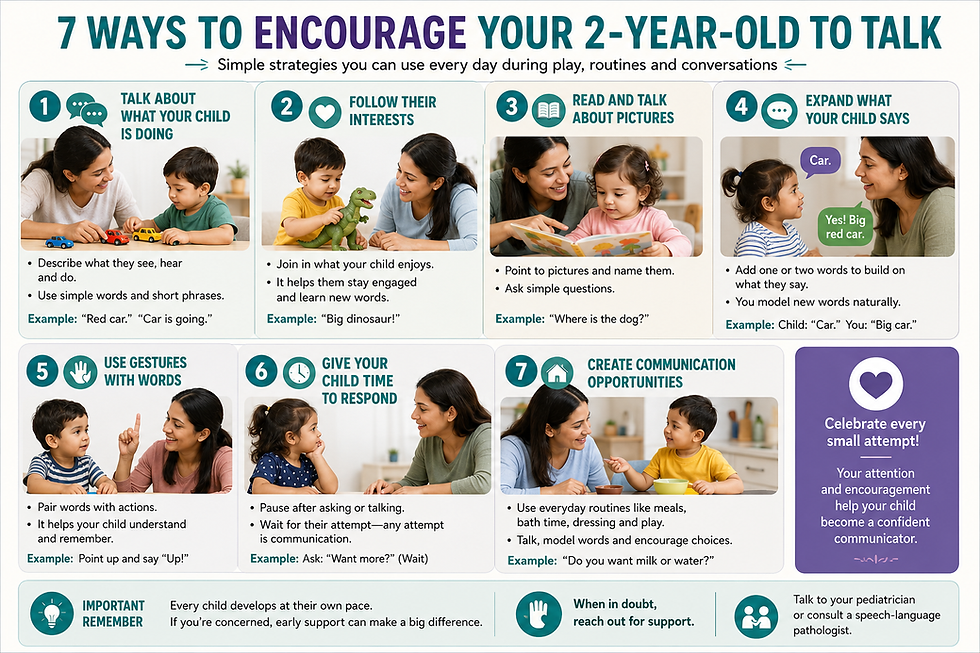
Talk About What Your Child Is Doing
Follow your child's interests.
If they're playing with a car, you might say:
"Car!"
Then build on it:
"Red car."
Or:
"The car is going."
This gives your child simple language models connected to what they already care about.
Follow Their Interests
If your child is fascinated by animals, talk about animals.
If they're interested in trains, talk about trains.
If they want to play with bubbles, use that opportunity to model words such as:
Bubble
More
Big
Pop
Again
Open
Language is easier to learn when it is connected to something meaningful.
Read and Talk About Pictures
You don't need to read every word on every page.
Point to pictures and talk about what you see.
For example:
"Look! A dog."
"The dog is running."
"Where's the ball?"
If your child points rather than answers verbally, that's still communication. You can model the word for them.
Expand What Your Child Says
If your child says:
"Car."
you might respond:
"Big car."
If they say:
"Mama."
you might say:
"Mama's here."
This technique gives your child a slightly more advanced language model without demanding that they repeat it.
Use Gestures With Words
Pairing words with gestures can make their meaning easier to understand.
For example:
Point while saying "there."
Hold your hands apart while saying "big."
Wave while saying "bye-bye."
Point to your mouth while saying "eat."
Gestures aren't a replacement for speech. They are another useful way for children to understand and express meaning.
Give Your Child Time to Respond
After asking a question or modeling a word, pause.
Don't immediately answer for your child.
They may respond by:
Saying a word
Attempting a word
Making a sound
Pointing
Gesturing
Looking at the object
Using another communication method
A meaningful response doesn't have to be perfectly pronounced.
Create Communication Opportunities During Daily Routines
Everyday activities can become language opportunities.
During meals:
"More banana?"
During dressing:
"Shirt or pajamas?"
During bath time:
"Wash hands."
During play:
"Open the box."
During cleanup:
"Blocks in."
Repeated language within familiar routines can help children connect words with actions and objects.
Should My 2-Year-Old See a Speech Therapist?
If you're concerned about your child's communication, you don't need to wait for them to get older before seeking guidance.
A speech-language pathologist can evaluate areas such as:
Receptive language
Expressive language
Vocabulary
Word combinations
Gestures
Social communication
Speech production
Play and interaction
Functional communication
The evaluation isn't simply about counting words.
Two children who both say only five words may have very different communication profiles.
One may understand a lot, point, imitate, engage socially, and be rapidly gaining new skills.
Another may have difficulty understanding language, rarely communicate intentionally, and show little progress.
The evaluation helps distinguish these patterns.
What Does Speech Therapy for a 2-Year-Old Look Like?
Speech therapy at this age should generally feel more like play and interaction than formal lessons.
An SLP may use:
Toys
Books
Bubbles
Pretend play
Songs
Pictures
Puzzles
Everyday routines
Turn-taking games
Therapy goals may include:
Building vocabulary
Helping the child learn and use useful words during meaningful activities.
Combining words
Encouraging early two-word combinations and gradually more complex communication.
Understanding language
Supporting comprehension of words, directions, questions, and concepts.
Increasing communication attempts
Helping the child learn reliable ways to request, protest, comment, ask for help, and interact.
Supporting parents
Showing caregivers how to create language opportunities throughout everyday routines.
Sounderic's guide on how speech therapy works for 2-year-olds provides a more detailed look at what parents can expect from therapy at this age.
The focus should be on functional communication, not simply making a child repeat words.
Myth vs. Fact: 2-Year-Old Speech and Language Development
When a 2-year-old isn't talking, parents often hear conflicting advice. Some people may say, "They'll talk when they're ready," while others may immediately suggest a specific diagnosis. Neither approach gives you the complete picture.
Myth: "My 2-year-old understands everything, so there can't be a language delay."
Fact: Understanding language and expressing language are different skills.
A child can have relatively strong receptive language while having difficulty expressing themselves through words and phrases.
Understanding is an encouraging strength, but it doesn't automatically explain why a child isn't talking.
Myth: "My 2-year-old is babbling, so they'll definitely start talking soon."
Fact: Babbling is an important form of early vocal communication, but it doesn't allow anyone to predict exactly when a child will begin using meaningful words.
At age 2, it's useful to consider babbling alongside vocabulary, word combinations, gestures, comprehension, imitation, social interaction, and progress over time.
Myth: "Every 2-year-old must know exactly 50 words."
Fact: There isn't a single word count that can diagnose a language disorder.
ASHA's 19–24-month milestones include using and understanding at least 50 different words, while the CDC's current 2-year milestone includes saying at least two words together. (asha.org; cdc.gov)
These milestones are useful reference points, but children's development doesn't happen according to an exact schedule.
Myth: "A 2-year-old who isn't talking should just wait until age 3."
Fact: You don't necessarily need to wait.
If your child has very few words, isn't combining words, has difficulty understanding language, or isn't gaining communication skills, discussing your concerns with a pediatrician or speech-language pathologist can help.
Early evaluation doesn't mean that your child will necessarily need long-term therapy. It provides information about what your child is doing well and where additional support may be useful.
Myth: "Not talking at 2 automatically means autism."
Fact: Not talking is not enough to diagnose autism.
Speech delay can have many possible explanations, including expressive language difficulties, hearing differences, speech-production difficulties, and broader developmental differences.
Autism involves a broader pattern of social communication differences and restricted or repetitive behaviors. If you're concerned about several aspects of your child's development, discuss them with your child's healthcare provider.
Myth: "If my child can't talk, there's nothing they can do to communicate."
Fact: Children can communicate in many ways besides spoken words.
Gestures, pointing, facial expressions, signs, pictures, communication boards, and AAC can all provide meaningful ways for a child to communicate.
The goal is to give your child a reliable way to express needs, wants, ideas, and feelings while supporting their overall communication development.
How Can Sounderic Help?
If your 2-year-old isn't talking, has very few words, or isn't combining words, a speech-language evaluation can help you understand what may be happening.
Sounderic provides online speech and language therapy designed around each child's communication needs.
An SLP can assess areas such as:
Receptive language
Expressive language
Vocabulary
Word combinations
Gestures
Social communication
Speech production
Functional communication
Therapy for a 2-year-old isn't simply about making them repeat words. It can involve play, books, songs, routines, turn-taking, parent coaching, and activities designed around the child's interests.
You can learn more about how speech therapy works for 2-year-olds and what parents can expect from an early intervention approach.
If you're unsure whether your child would benefit from professional guidance, Sounderic's speech therapy evaluation resource can also help you understand when an evaluation may be appropriate.
Frequently Asked Questions
Is it normal for a 2-year-old not to talk?
Children develop communication skills at different rates, but a 2-year-old with very few or no meaningful words, who isn't combining words, or who has other communication concerns should be discussed with a pediatrician or speech-language pathologist. The CDC's current 2-year milestone includes saying at least two words together. (cdc.gov)
How many words should a 2-year-old say?
There isn't one universal vocabulary number that determines whether a 2-year-old is developing normally. ASHA's 19–24-month communication milestones include using and understanding at least 50 different words, while the CDC's current 2-year milestone emphasizes saying at least two words together. (asha.org; cdc.gov) Vocabulary should be considered alongside comprehension, gestures, word combinations, social communication, and progress.
What if my 2-year-old isn't talking but understands everything?
A child can have stronger receptive language than expressive language. They may understand directions, recognize familiar words, and communicate through gestures while having difficulty expressing themselves with spoken words. Strong understanding can be an important strength, but it doesn't rule out an expressive language delay. An SLP can evaluate both receptive and expressive language.
Why is my 2-year-old not talking but babbling?
Babbling shows that your child is using vocal communication, but by age 2 it's also important to look at meaningful words, word combinations, gestures, understanding, imitation, social interaction, and communication progress. If your child is primarily babbling and has very few or no meaningful words, discussing your concerns with a pediatrician or SLP can help determine whether an evaluation would be useful.
Should a 2-year-old be talking in sentences?
A 2-year-old is generally beginning to combine two or more words, although sentences at this age are usually short and grammar may still be developing. ASHA's 19–24-month milestones include putting two or more words together. (asha.org) If your child consistently uses only sounds or isolated words and isn't beginning to combine words, consider discussing it with an SLP.
What causes speech delay in a 2-year-old?
Possible contributors include expressive language difficulties, receptive-expressive language difficulties, hearing loss, speech sound or motor-speech difficulties, autism or other social communication differences, broader developmental differences, and certain neurological, genetic, or medical conditions. An evaluation is needed to understand the reason for an individual child's communication difficulties.
Does not talking at 2 mean my child has autism?
No. Not talking by itself does not diagnose autism. Autism involves a broader pattern of social communication differences and restricted or repetitive behaviors. A child who isn't talking should be evaluated based on their complete developmental and communication profile rather than spoken language alone.
What should I do if my 2-year-old has no words?
Start by discussing your concerns with your child's pediatrician and consider a speech-language evaluation. A hearing assessment may also be appropriate. In the meantime, continue talking, reading, playing, and interacting with your child, while giving them opportunities to communicate through words, sounds, gestures, pointing, or other communication methods.
When should a 2-year-old see a speech therapist?
Consider a speech-language evaluation if your child has no meaningful words, uses very few words, isn't combining words, has difficulty understanding language, rarely communicates intentionally, has limited gestures or social interaction, isn't making progress, or has lost communication skills they previously had. You don't have to wait until age 3 to ask for professional guidance.
Conclusion
If your 2-year-old isn't talking but seems to understand everything, it's understandable to feel both reassured by their understanding and worried about their lack of spoken language.
Strong receptive language can be an important strength. But it doesn't automatically mean that your child's expressive language is developing as expected.
Likewise, a child who is babbling but not talking may be actively communicating through sounds, but babbling alone doesn't tell us when meaningful words will emerge.
At age 2, it's helpful to look at the whole communication picture:
How many meaningful words does your child use?
Are they beginning to combine words?
Do they understand familiar language?
Can they follow directions?
Do they point or use other gestures?
Do they imitate sounds or actions?
Do they try to communicate with you?
Do they share attention or show you interesting things?
Are they gaining new communication skills?
Have they lost any skills they previously had?
The CDC's current 2-year milestones include saying at least two words together, pointing to things in a book when asked, pointing to body parts, and using more gestures beyond simply waving and pointing. (cdc.gov)
ASHA's 19–24-month milestones provide additional expectations around vocabulary, word combinations, following directions, and functional communication. (asha.org)
These milestones aren't a diagnosis or a reason to compare your child with every other toddler. They are useful reference points for understanding development.
If your child has very few or no words, isn't combining words, has difficulty understanding language, or has other developmental concerns, you don't need to wait and hope the problem disappears.
A pediatrician, audiologist, or speech-language pathologist can help you understand your child's communication profile and determine whether additional support would be helpful.
And if your child isn't using spoken words, remember that communication is much broader than speech. Gestures, signs, pictures, and AAC can give children meaningful ways to express themselves while spoken language develops—or alongside it.
The most important question isn't simply:
"Why isn't my 2-year-old talking like other children?"
It's:
"How is my child communicating right now, what are their strengths, and what can we do to help them communicate more effectively?"
Seeking guidance doesn't mean something is necessarily wrong. It means you're giving yourself the information you need to support your child's communication development.