

Why Is My Toddler Not Talking Yet? Understanding Late Talkers [Answer from SLP]

Updated: Oct 29, 2025
If you’ve ever searched “Why is my toddler not talking yet?” or felt a pang of worry when you see other children chattering away while yours stays quiet, you’re not alone. Many parents share this concern, and the term “late talker” is often used to describe children who seem to be developing normally in every way except speech. Interestingly, boys are statistically more likely to be late talkers than girls.
Who is a Late Talker?
Late Talkers are typically developing children between 18 and 30 months old who have age appropriate cognitive, motor and social skills, but limited spoken vocabulary. They understand most of what’s said to them, plays and interact socially like other children their age, but don’t use as many words as expected. They may point, gesture, and show good comprehension of what's being said or told to them, but the words they use to communicate are limited.
You’ve probably heard people say things like,
“Don’t worry, my cousin didn’t talk until he was three,” or “Just give it time! Every child develops at their own pace.”
While that’s sometimes true, it’s not always the case.
Some children are simply “Late Bloomers” and catch up naturally, but others may have an underlying language disorder that benefits from early support. Since it’s hard to tell which group a child will fall into, it’s best not to take a “wait and see” approach. Instead, keep a close eye on your child’s progress and seek a professional opinion if you have concerns.

What Are The Most Common Risk Factors?
Late talking results from a mix of biological and environmental factors. Research shows that children with a family history of speech delay or learning disability or children with developmental delay in other domains are more likely to talk later. So are those who were born prematurely (Born before 37 weeks gestation), had low birth weight (Less tha 85% of optimal weight), or experienced hearing issues, even temporary ones from frequent ear infections.
While growing up in a multilingual home can sometimes delay communication in one language, it doesn’t harm long-term language skills; rather, it often strengthens overall communication once the child starts combining words.
Likewise, Environmental and Psychosocial factors also play a role. Children who spend a lot of time with screens instead of face-to-face conversation might have fewer opportunities to practice using words due to reduced interaction and limited speech stimulation. This doesn’t mean parents are at fault! But it does mean that the amount and quality of everyday interaction truly matter.
How Common Is Late Talking?
Late talking is surprisingly more common. Studies suggest that around 10–20% of toddlers aged 18 to 30 months show signs of being late talkers. Many of them will go on to develop typical speech and language skills, especially if their understanding of language is strong and there are no other developmental concerns.
But, research also shows that some late talkers continue to face challenges later in childhood, like difficulties with grammar, reading, or academic language. That’s why regular monitoring and early support make such a difference.
About 13% of all 2-year-old children are late talkers.
Signs and Red Flags That Your Child Might Be a Late Talker
The following diagram shows the speech milestones of a typically developing child.
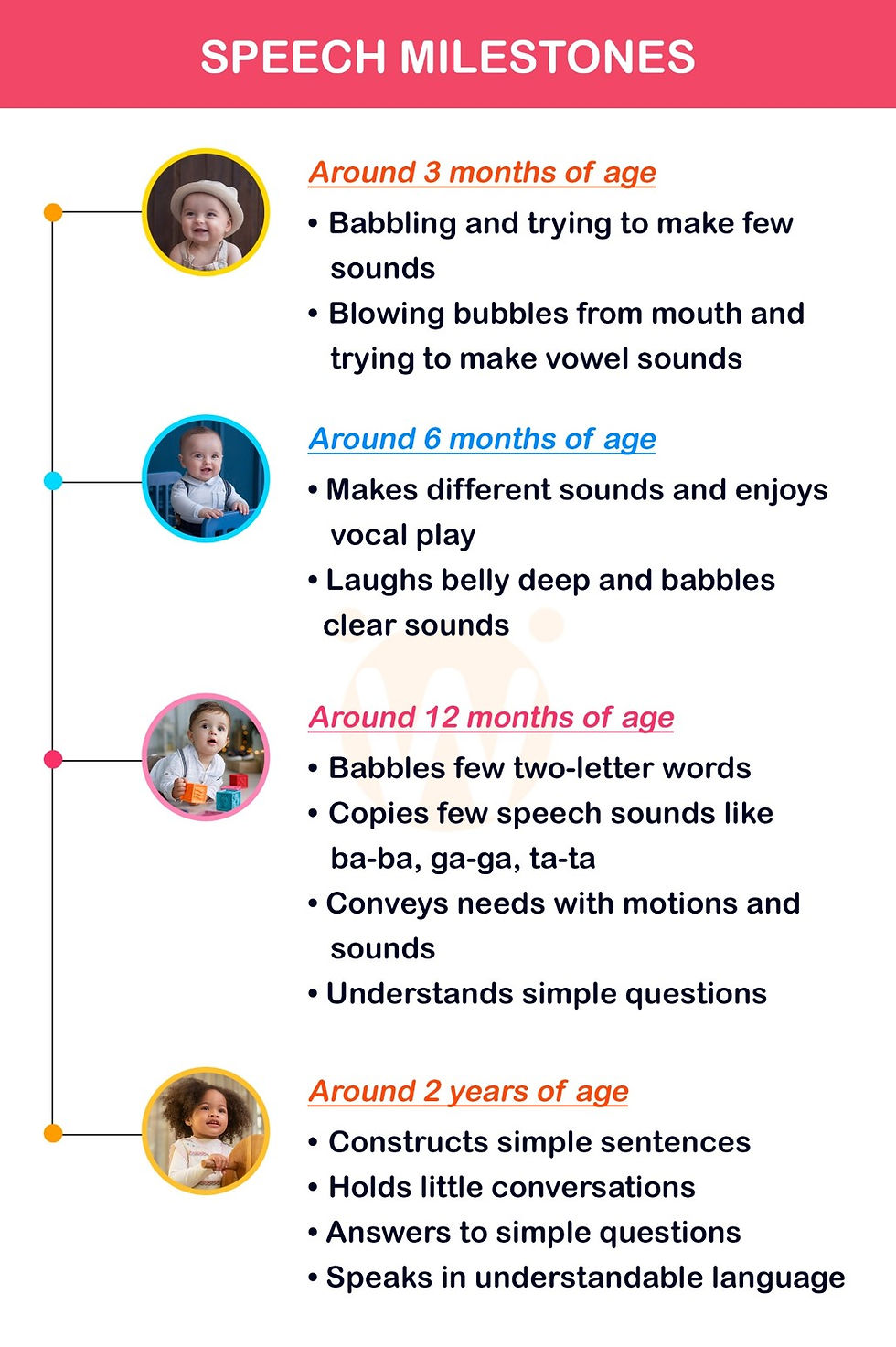
Parents often sense when something feels “off,” even before others notice. While every child develops at their own pace, here are some general milestones to keep in mind:
If your child isn’t babbling or pointing by 12 months, isn’t using any words by 18 months, or still isn’t combining words by 24–30 months, it’s worth bringing up with a speech-language pathologist (SLP).
Other red flags include
Difficulty following simple instructions
Not responding to name or familiar sounds
Frustration when trying to communicate.
Even if your child understands you well but doesn’t say much, it’s still a good idea to check in. Sometimes receptive language (understanding) develops faster than expressive language (speaking), but an evaluation helps ensure nothing important is being missed.
What Should Parents Do If Their Child Is a Late Talker?
If you suspect your toddler might be a late talker, the most important thing to remember is that you don’t have to wait and see. The most important step is to get your child evaluated early.
Consult a Speech-Language Pathologist (SLP)
A speech-language pathologist is trained to assess your child’s communication skills in detail ; not just how many words they say, but also how they understand, imitate, and interact. Through play-based evaluation, the SLP can identify whether your child is simply a “late bloomer” or may have an underlying language delay that needs support.
This professional insight is invaluable because some children who start talking late catch up on their own, while others continue to face challenges without help. An early assessment helps you make informed choices rather than relying on guesswork or well-meaning advice like “just give it time.”
Early Intervention Works — Even for “Late Bloomers”
There’s strong evidence that early intervention leads to better communication outcomes, even for children who might have eventually caught up on their own! Think of it as giving your child an early boost, rather than “fixing” a problem.
Early speech therapy is usually fun and play-based, focusing on helping your child communicate more effectively through words, gestures, and social interaction. The earlier your child learns these skills, the easier it becomes for them to build on them later.
Avoid the “Wait and See” Approach
It’s natural to hope things will improve over time, especially when friends or family share stories about children who “just started talking one day.” However, research shows that delaying intervention can mean missing a critical window of brain development when language learning happens most easily.
The “wait and see” approach can lead to frustration for both parents and children. In some cases, it allows small communication gaps to widen over time. Getting professional advice early doesn’t necessarily mean starting therapy right away; it simply means having a clear picture of where your child stands and what kind of support, if any, is needed.
How Parents Can Encourage Speech at Home
Whether your child is already in therapy or you’re waiting for an evaluation, there’s a lot you can do at home to help.

Talk to your child throughout the day! While getting dressed, cooking, or playing. Describe what you see and do (“You’re wearing your red socks!” “Let’s open the door”).
Have Interactive Reading sessions and Singing Sessions where you model the language and encourage imitation for the child.
More than questioning your child and saying "What is this?", "Say the name now" repeatedly. Comment on the things the child is playing with. Children learn by observing their surroundings.
When your child uses a word, build on it. If they say “car,” you can add, “Yes, the car is going fast!” These little expansions help your child move from single words to phrases.
Play face to face along with the child and follow their lead.
Reduce screen time and replace it with real conversation and interactive play.
Most importantly, keep the pressure off! Children learn best when they’re having fun and feel understood.
Frequently Asked Questions (FAQ)
Is late talking a sign of autism or intellectual disability ?
Not necessarily. Many late talkers are otherwise developing typically. However, if you notice differences in how your child plays, makes eye contact, or responds to social interaction, it’s important to discuss this with your pediatrician or SLP and have a full developmental evaluation..
Can bilingual homes cause late talking?
No. Being raised in a bilingual or multilingual home does not cause speech delays. Bilingual children might use fewer words in each language, but when you combine their total vocabulary across both, it’s often on par with other children their age. Far from being a disadvantage, bilingualism supports flexible thinking and stronger language skills in the long run.
Will my child catch up naturally?
Some will, but others may continue to struggle with language or literacy later on. Because it’s hard to predict, professional monitoring is always recommended.
Should I worry if my child understands but doesn't use many words?
A strong understanding is a great sign, but the ability to speak should still be developing alongside it. If your child seems to understand what’s said but uses very few words by age two, or isn’t combining words by around 30 months, it’s worth checking in with a speech-language pathologist. Sometimes, children just need a boost in learning how to use the words they already know.
How is speech therapy for late talkers different from other therapies?
Speech therapy for late talkers is playful, interactive, and rooted in your child’s everyday activities. It often involves parent coaching, modeling language, encouraging imitation, and building vocabulary through natural routines and games.
When should medical Hearing tests be considered?
If a child isn’t talking as expected or doesn’t always respond to sounds, a hearing test is one of the first steps. Even mild hearing issues like fluid buildup or frequent ear infections can make it harder for children to pick up new words. A quick check with an audiologist helps rule out hearing loss and ensures that therapy, if needed, is built on a solid foundation.
When and How to Seek Professional Help
If your toddler isn’t talking as expected and you notice the Red Flags discussed above, don’t wait until preschool to act. The earlier you address a language delay, the better the long-term outcomes.
Your first step can be your pediatrician, who can rule out medical or hearing-related causes. They may refer you to a speech-language pathologist (SLP) for a detailed communication assessment. An SLP evaluates how your child listens, understands, and uses words, as well as how they play and interact socially.
At Sounderic, we offer online speech therapy sessions tailored to each child’s needs — whether your toddler is just starting to use words or needs help combining them into sentences. Our goal is to make therapy simple, accessible, and effective for families everywhere. Together, we’ll create a plan that helps your child find their voice — one word at a time.
Get in touch with us on WhatsApp at +919644466635 or schedule a consultation with us at https://www.sounderic.com/service-page/speech-language-consultation-for-kids
Follow us on Facebook, and Instagram or join our community of 18,000 parents from all across the world here, "Speech therapy guide for parents".
Read more:
References:


